
Blog
What is a Depreciation Schedule?
A depreciation schedule is the structured table that tracks how an asset's cost is allocated as expense over its useful life. For machinery and equipment owners, understanding the difference between book depreciation and real market value can be the difference between accurate insurance coverage and a costly gap.
A depreciation schedule is a table that shows, year by year, how a fixed asset's cost is expensed, how much depreciation has accumulated, and what net book value remains. For machinery and equipment, it is one of the most referenced documents in accounting, tax planning, and financial reporting. But it is also one of the most misunderstood: the number on line 5 of your fixed asset schedule and the number a buyer would pay for that same machine on the open market are rarely the same figure. Understanding both, and the gap between them, matters for insurance, financing, asset sales, and financial reporting.
What a Depreciation Schedule Is
A depreciation schedule is a structured record that calculates and tracks the reduction in an asset's book value over time. As MyAccountingCourse describes it, it is "a chart that calculates an asset's depreciation expenses based on its purchase date, cost, useful life, and method."
Every schedule for a depreciable asset captures at least the following elements:
Asset description: what the asset is (e.g., "CNC lathe", "forklift", "injection molding press")
Date of acquisition: when the asset was placed in service
Original cost or basis: the capitalized purchase price, including freight, installation, and taxes where applicable
Estimated useful life: the period over which the asset will be depreciated
Salvage (residual) value: the estimated remaining value at the end of useful life, if any
Depreciation method: the formula used to allocate cost each period
Depreciation expense: the current-period charge
Accumulated depreciation: the total expensed to date
Net book value: original cost minus accumulated depreciation at period end
In financial modeling, the schedule also supports balance sheet, income statement, and cash flow projections. As Corporate Finance Institute notes, a well-built depreciation schedule allows analysts to forecast property, plant, and equipment (PP&E) balances, depreciation expense, and capital expenditures in a way that keeps all three financial statements internally consistent.
For a company operating a fleet of manufacturing equipment, the depreciation schedule is also a living document. New assets are added as capital expenditures are made, retired assets are removed, and the schedule rolls forward each period.
What Assets Qualify for Depreciation
An asset qualifies for depreciation when it meets three conditions: it is owned by the taxpayer (or business), it is used in a trade or business or for income production, and it has a determinable useful life of more than one year.
For machinery and equipment, those criteria are almost always satisfied. Manufacturing equipment, processing machinery, vehicles used in the business, computers, and office equipment all qualify. Land does not qualify, for tax purposes or for appraisal purposes. Land is not a wasting asset; it does not wear out, and no depreciation is permitted or appropriate.
Intangible assets can also be depreciated (or amortized), but the focus here is tangible personal property: the physical machines and equipment that form the productive core of a manufacturing, processing, or industrial operation.
Depreciation Methods: Straight-Line, Declining Balance, and Others
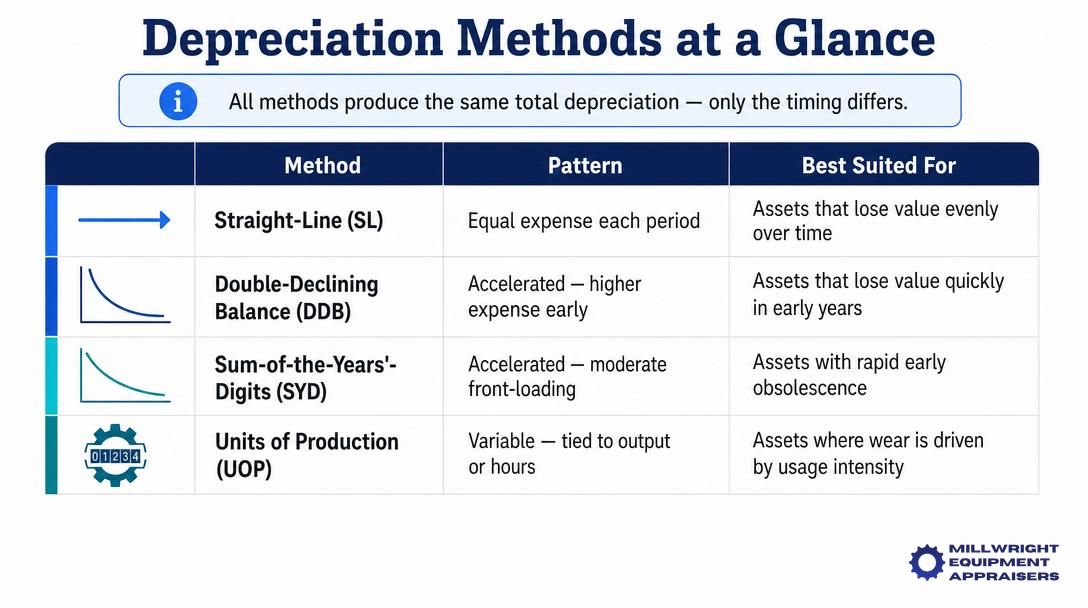
The depreciation method determines how cost is allocated across periods. Each method produces the same total depreciation over the asset's life. What differs is the timing.
The table below summarizes the four primary methods:
Method | Pattern | Best Suited For |
|---|---|---|
Straight-line (SL) | Equal expense each period | Assets that lose value evenly over time |
Double-declining balance (DDB) | Accelerated; higher expense early | Assets that lose value quickly in early years |
Sum-of-the-years'-digits (SYD) | Accelerated; moderate front-loading | Assets with rapid early obsolescence |
Units of production (UOP) | Variable; tied to output or hours | Assets where wear is driven by usage intensity |
Straight-Line
Straight-line is the simplest method. Annual depreciation equals depreciable cost divided by useful life.
Example: A press brake is purchased for $110,000 with a $10,000 estimated salvage value and a 10-year useful life. Depreciable cost is $100,000. Annual depreciation is $10,000 per year. At the end of year 3, accumulated depreciation is $30,000 and net book value is $80,000.
Double-Declining Balance
Double-declining balance (DDB) applies twice the straight-line rate to the beginning net book value each period. It is the method underlying MACRS for most machinery and equipment (more on that below). The result is larger deductions in early years, which accelerates tax benefits.
Example: Using the same $110,000 press brake (ignore salvage for DDB purposes under MACRS), a 10-year life gives a straight-line rate of 10%. Doubled, that is 20%. Year 1 depreciation: $110,000 x 20% = $22,000. Year 2: ($110,000 - $22,000) x 20% = $17,600. The schedule switches to straight-line when straight-line produces a higher deduction.
Sum-of-the-Years' Digits
SYD applies a declining fraction to depreciable cost. The denominator is the sum of the digits of the useful life. For a 5-year asset: 1+2+3+4+5 = 15. Year 1 uses 5/15, year 2 uses 4/15, and so on. It is an accelerated method less commonly used in practice today but still taught as a conceptual framework.
Units of Production
UOP ties depreciation to actual output: hours run, units produced, or miles driven. It is appropriate for equipment whose wear is driven entirely by usage rather than the passage of time. A stamping press that runs two shifts one year and is mothballed the next will show very different depreciation expense under UOP compared to straight-line. For equipment appraisal purposes, UOP assets require reliable usage records to support the depreciation calculation.
MACRS: The Tax Depreciation System for Machinery and Equipment
For U.S. federal income tax, almost all machinery and equipment is depreciated under the Modified Accelerated Cost Recovery System (MACRS), codified in IRC §168. MACRS was enacted in 1986 and superseded the Accelerated Cost Recovery System (ACRS) that preceded it.
MARS has two systems:
General Depreciation System (GDS): the default; uses accelerated methods and shorter recovery periods.
Alternative Depreciation System (ADS): required in certain circumstances (e.g., listed property used outside the U.S., certain tax-exempt use property, some farm equipment elections); uses longer recovery periods and straight-line.
Most manufacturing and industrial equipment falls under GDS, in either the 5-year or 7-year property class, based on the asset's class life as defined in Rev. Proc. 87-56:
5-year property: class life more than 4 but less than 10 years. Includes computers, certain light manufacturing equipment, and farm tractors placed in service after 2017.
7-year property: class life 10 years or more but less than 16 years. Includes general manufacturing equipment and office furniture. This is the most common class for industrial machinery.
Under GDS, both classes use the 200% declining balance method with the half-year convention, switching to straight-line when straight-line produces a larger deduction. The half-year convention treats all assets as placed in service at the midpoint of the tax year, regardless of the actual date. IRS Publication 946 contains the full percentage tables (Appendix A) that translate these rules into ready-to-use annual percentages.
Example: A 7-year GDS asset with a $200,000 cost basis. Under the MACRS percentage table for 7-year property (200DB, half-year convention), the Year 1 percentage is 14.29%. Year 1 depreciation: $200,000 x 14.29% = $28,580. Year 2: $200,000 x 24.49% = $48,980. The percentages front-load the deductions and then taper as the schedule switches to straight-line in later years.
For income approach valuations of process plants, it is common practice to use a 10-year MACRS schedule for the machinery and equipment component and a 39-year straight-line schedule for buildings. These are the tax lives used in discounted cash flow models when deriving depreciation expense as a noncash charge within the income statement projection.
Watch out: MACRS class lives and recovery periods are defined by statute and IRS guidance. They do not necessarily reflect how long an asset will actually be used or how quickly it loses economic value. A CNC machining center assigned to the 7-year MACRS class may have a productive life of 20 years or a market life of 5 years, depending on the technology cycle. The tax schedule tells you nothing reliable about either.
Section 179 and Bonus Depreciation: Accelerated Options
Two provisions allow businesses to deduct the cost of qualifying equipment much faster than the standard MACRS schedule.
Section 179 (IRC §179)
Section 179 allows a taxpayer to elect to expense (immediately deduct) the cost of qualifying property in the year it is placed in service, rather than depreciating it over time. The election applies to most new and used machinery and equipment. It is subject to a dollar limit and a phase-out threshold that adjust annually for inflation.
The table below shows the 2024 and 2025 limits:
Year | Maximum Section 179 Deduction | Phase-Out Threshold |
|---|---|---|
2024 | $1,220,000 | $3,050,000 |
2025 | $2,500,000 | $4,000,000 |
The 2024 figures are per Rev. Proc. 2023-34. The 2025 figures reflect the substantial increases enacted for 2025. Above the phase-out threshold, the Section 179 deduction is reduced dollar-for-dollar. The deduction is also limited to the taxpayer's taxable income from active business activity.
Bonus Depreciation (IRC §168(k))
Bonus depreciation allows an additional first-year deduction on the adjusted basis of qualifying property. Unlike Section 179, bonus depreciation is not subject to an income limitation, which makes it valuable for companies with large capital expenditure programs.
The bonus depreciation percentage has been phasing down since the Tax Cuts and Jobs Act (TCJA) set it at 100% for property placed in service from September 27, 2017 through 2022. The phase-out schedule under current law:
2024: 60%
2025: 40% (under the existing TCJA schedule)
Note that legislation introduced in 2025 (the One Big Beautiful Bill Act) proposes restoring 100% bonus depreciation for property acquired and placed in service after January 19, 2025. As of the date of this post, that proposal is moving through Congress and advisors should confirm current law before planning.
Pro tip: Section 179 and bonus depreciation can be used together in the same year, stacked in a specific order (Section 179 first, then bonus). For a company placing $5,000,000 of new equipment into service in 2025, the combination of both provisions can eliminate the tax depreciation schedule almost entirely in year one. That is powerful for cash flow, but it also means the book value of that equipment drops to near zero immediately, regardless of its actual condition or market value.
Book Depreciation vs. Fair Market Value: Why They Diverge
This is the section that matters most for plant managers, CFOs, and anyone making decisions based on equipment values.
MACS book depreciation is a formula. It takes a cost basis, applies a statutory percentage, and produces a number. It does not know whether the market for used equipment in your asset class has collapsed or surged. It does not know that your press was rebuilt last year. It does not know that the model has been superseded by a superior technology. It does not know that you have maintained the equipment meticulously or run it into the ground.
As a result, net book value and fair market value routinely diverge, sometimes by a wide margin, in either direction.
Here are the three most common divergence scenarios:
Fully depreciated but still productive: Many manufacturers operate equipment that has been on the books for 7 or 10 years and carries a net book value of zero. The equipment is still running and still has real market value. A zero book value does not mean a zero insurance limit or a zero transaction price.
Rapid obsolescence: Technology-driven assets (certain automated systems, computerized controls, specialized robotics) can lose market value faster than MACRS allows. A piece of equipment in its third year of a 7-year schedule may already be worth 20 cents on the dollar in the used equipment market because its technology has been superseded.
Market appreciation: For some heavy machinery classes, used equipment prices have outpaced replacement costs due to supply chain disruptions, production backlogs from OEMs, and commodity-driven demand cycles. Book value, anchored to original cost less MACRS depreciation, will lag significantly behind current market prices.
The core point: book depreciation measures tax timing, not economic reality. Appraisers measure economic reality.
How a Professional Appraisal Accounts for Depreciation
When our appraisers prepare a machinery and equipment valuation under the cost approach, depreciation is not pulled from a tax schedule. It is measured from the market.
The cost approach starts with the cost to replace the asset new (either reproduction cost new or replacement cost new), then deducts three forms of depreciation:
Physical deterioration: The loss in value due to wear, age, and deferred maintenance. It is measured against the asset's expected total useful life and its actual observed condition.
Functional obsolescence: Loss in value due to deficiencies in the asset itself: excess operating costs compared to a modern equivalent, reduced capacity, outdated controls, or a design that no longer meets production requirements.
Economic (external) obsolescence: Loss in value caused by factors outside the asset, including market conditions, industry overcapacity, regulatory changes, or a softened demand environment for the output the asset produces.
These three forms of depreciation are applied in sequence, not combined and deducted all at once. The logic follows the asset's life cycle: physical deterioration accrues from use, functional obsolescence emerges as technology advances, and economic obsolescence is imposed by the environment in which the asset operates.
Market-Based Depreciation Curves
For portfolios of similar equipment, our appraisers develop market-based depreciation curves rather than appraising each machine individually from scratch. Used equipment market data is analyzed, a trend line is developed across age and condition cohorts, and a depreciation multiplier is applied to replacement costs across the asset group. This is especially efficient for large inventories of standard industrial equipment where a statistically meaningful pool of market transactions exists.
For specialized or one-of-a-kind assets, individual assessment is required. There may be no market transactions to analyze, so physical inspection, engineering judgment, and comparable cost data carry more weight.
A Note on Assemblage Costs
For fair market value in continued use (FMVICU) and fair market value installed (FMVI) conclusions, our appraisers include and then depreciate all assemblage costs: freight, rigging, installation, electrical connections, and applicable taxes. These costs represent real economic investment in the asset as it sits in place. This treatment reflects the position of the American Society of Appraisers Machinery and Technical Specialties Committee and is consistent with USPAP-compliant methodology.
Internal Records Are Often More Reliable Than the Fixed Asset Schedule
One practical point worth raising: accounting fixed asset schedules frequently contain errors that reduce their reliability for appraisal purposes. Ghost assets (equipment that has been scrapped, sold, or transferred but remains on the books) are common. So are merged line items that group multiple machines under a single entry.
For appraisal engagements, the most reliable starting point is often the maintenance department's equipment list, the IT department's hardware inventory, or the plant manager's operational asset list. These records tend to reflect what is actually on the floor, in working condition, ready to produce. Cross-referencing accounting records against operational records is a standard step in our engagement process.
Quick-Reference Summary
The table below consolidates the key depreciation concepts covered in this post:
Concept | Key Facts |
|---|---|
Depreciation schedule | Tracks cost, accumulated depreciation, and net book value by period |
Qualifying assets | Tangible property used in business with a determinable useful life; land does not qualify |
MACRS GDS (most M&E) | 5-year or 7-year class; 200% declining balance; half-year convention; per IRC §168 |
MACRS tables | IRS Publication 946, Appendix A |
Section 179 (2024) | Max deduction $1,220,000; phase-out at $3,050,000 |
Section 179 (2025) | Max deduction $2,500,000; phase-out at $4,000,000 |
Bonus depreciation (2024) | 60% of qualifying property cost |
Bonus depreciation (2025) | 40% under TCJA schedule (100% proposed under OBBBA) |
Book value vs. FMV | Book value follows tax rules; FMV follows market conditions; they routinely diverge |
Appraisal depreciation | Physical deterioration + functional obsolescence + economic obsolescence, applied in sequence |
Credential standard | USPAP-compliant; appraisers credentialed with ASA and CAGA |
Get a Defensible Equipment Value, Not Just a Book Number
If you are relying on your depreciation schedule to tell you what your equipment is worth for insurance limits, a sale, a financing package, or a financial statement, you are working from the wrong number. Book value is a tax and accounting construct. Fair market value is what the market would actually pay.
Our appraisers prepare USPAP-compliant machinery and equipment appraisals that reflect real market conditions, proper treatment of all three forms of obsolescence, and documentation built to withstand scrutiny from lenders, insurers, and auditors. If you need a defensible value for your equipment portfolio, request an appraisal or visit our heavy machinery appraisal page to learn more about how we work.
You can also review our FAQ on machinery valuation methods or read our guide on how to estimate salvage value of equipment.
Sources and Further Reading
MACRS rules, recovery periods, and Appendix A percentage tables: IRS Publication 946
2024 Section 179 dollar limits and phase-out threshold (Rev. Proc. 2023-34): RSM U.S. 2024 inflation adjustments summary
2025 Section 179 and bonus depreciation rates: DHJJ Tax Alert: Bonus Depreciation and Section 179 for 2025
TCJA 100% bonus depreciation phase-out schedule: Plante Moran: TCJA Bonus Depreciation Phase-Out
Depreciation schedule components and mechanics: Corporate Finance Institute: Depreciation Schedule
Depreciation schedule definition and structure: MyAccountingCourse: Depreciation Schedule
ASA Machinery and Technical Specialties credential and methodology: American Society of Appraisers
This article is provided for general informational purposes only and does not constitute legal, tax, or financial advice. Readers should consult a qualified attorney or CPA regarding their specific circumstances.