
Blog
Why Dealer and Auctioneer Estimates Fall Short of a USPAP Compliant Equipment Appraisal
A dealer quote or auctioneer estimate is a free sales tool, not an independent opinion of value. This guide explains why a USPAP-compliant equipment appraisal, prepared under Standards 7 and 8 by an appraiser with no stake in the transaction, is what the IRS, SBA lenders, and courts actually require.
A business owner calls three dealers for a quote on a used CNC machine, gets three different numbers, and assumes the highest one is closest to "real" value. That instinct causes trouble the moment the number needs to hold up somewhere official: an IRS filing, an SBA loan file, a divorce settlement, or a courtroom. A dealer quote and a USPAP compliant equipment appraisal are not interchangeable, and the difference is not just paperwork. It comes down to who is doing the estimating, why, and under what rules.
Millwright Equipment Appraisers prepares heavy machinery appraisal reports in accordance with USPAP for exactly this reason: the moment a valuation needs to be defensible to a third party, an informal quote stops being useful.
What Is a Dealer or Auctioneer Estimate, Really?
A dealer or auctioneer estimate is a sales tool, not an appraisal. It is typically free, produced quickly, and shaped by the commercial interest of the person giving it.
A dealer quoting a trade-in value wants to buy low and resell high. An auctioneer estimating what a piece of equipment will "bring at auction" wants consignments and wants bidders in the room, so pre-sale estimates can run low to spark interest or high to please the seller. Neither party is doing anything dishonest by industry norms. They are simply doing their job, and their job is not independent valuation. Industry guidance from the American Society of Appraisers notes plainly that auctioneers and dealers can carry a hidden agenda in these situations, whether that is winning a sale, securing a consignment, or protecting margin on a future purchase.
These estimates also tend to skip the analytical work an appraisal requires:
- No defined value standard. A dealer's number is rarely labeled as fair market value, orderly liquidation value, or forced liquidation value; it is usually just an asking price or trade-in figure.
- No documented scope of work. There is typically no record of what was inspected, what data was checked, or what comparable sales were considered.
- No independence disclosure. The party giving the number usually has a direct or indirect stake in the transaction.
- No certification. There is nothing signed attesting to methodology, assumptions, or compliance with any recognized standard.
Watch out: A dealer estimate isn't wrong to use when you're simply deciding whether to sell or trade in a machine. The problem starts when that same number gets submitted for a loan file, a tax return, or a legal proceeding where it was never designed to hold up.
What Makes an Appraisal USPAP-Compliant?
A USPAP-compliant equipment appraisal is an independent opinion of value developed and reported under Standards 7 and 8 of the Uniform Standards of Professional Appraisal Practice (USPAP), the ethics and performance standards published by The Appraisal Foundation. Standard 7 governs how the appraiser develops the value conclusion; Standard 8 governs how that conclusion is reported.
In practice, that means the appraiser must:
- Identify the asset precisely, including make, model, year, serial number, and configuration.
- Define the value being sought (fair market value, orderly liquidation value, or forced liquidation value) and the intended use of the report, whether that is collateral lending, tax reporting, litigation, or financial reporting.
- Disclose a scope of work, including whether the equipment was physically inspected and what market data was reviewed.
- Apply recognized valuation approaches, typically sales comparison and cost, and income where relevant, then reconcile them into a single supportable conclusion, an approach detailed in equipment and machinery appraisal methodology guidance.
- Sign a certification stating the work complies with USPAP, disclosing any assistance received and confirming the appraiser has no undisclosed interest in the outcome.
Our appraisers hold credentials with organizations such as the ASA, NEBB (through the Certified Machinery and Equipment Appraiser designation), and CAGA, and every machinery and equipment report is prepared in accordance with USPAP. That combination of credential and standard is what separates an appraisal from an estimate; USPAP itself is updated on a two-year cycle to keep pace with evolving appraisal practice).
Pro tip: Before requesting a report, ask what value standard the appraiser will use. Fair market value, orderly liquidation value, and forced liquidation value can produce very different numbers for the same machine, and the intended use dictates which one applies.
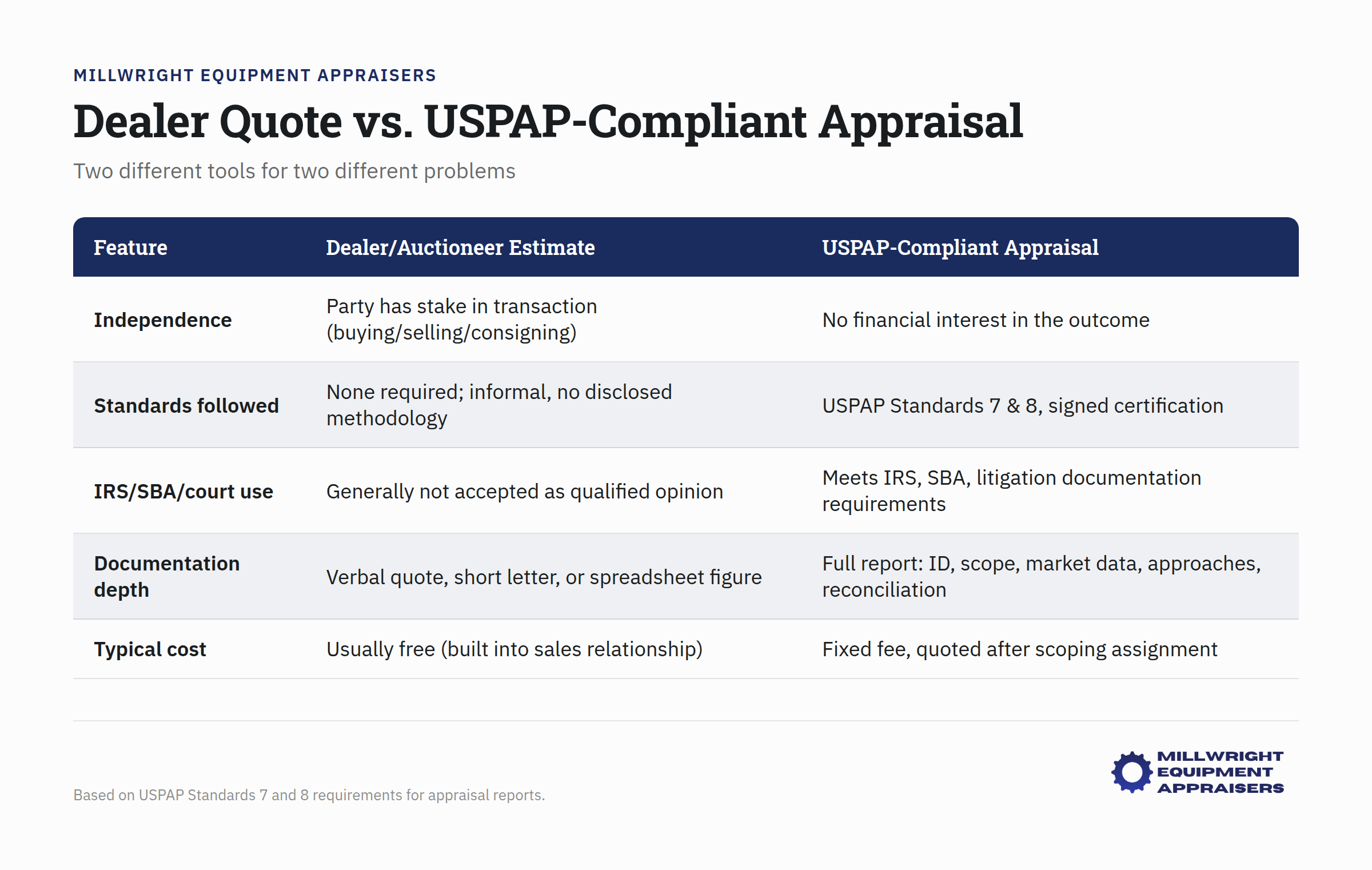
Dealer Quote vs. USPAP-Compliant Appraisal at a Glance
The two options solve different problems, and the table below makes the practical differences concrete.
| Feature | Dealer or Auctioneer Estimate | USPAP-Compliant Appraisal |
|---|---|---|
| Independence | Party has a stake in the transaction (buying, selling, or consigning) | Appraiser has no financial interest in the outcome |
| Standards followed | None required; informal, no disclosed methodology | USPAP Standards 7 and 8, with a signed certification |
| IRS / SBA / court use | Generally not accepted as a qualified appraisal or expert opinion | Prepared to meet IRS, SBA, and litigation documentation requirements |
| Documentation depth | Verbal quote, short letter, or spreadsheet figure | Full report: asset identification, scope of work, market data, valuation approaches, reconciliation |
| Typical cost | Usually free (built into the sales relationship) | Fixed fee, quoted after scoping the assignment |
Why the IRS Requires an Independent Appraiser for Charitable Donations
The IRS requires a qualified appraisal for non-cash charitable donations of equipment valued over $5,000, and that appraisal must come from a qualified appraiser with no relationship to the donor or the transaction. The regulations governing charitable-contribution appraisals specifically bar the donor, the dealer who sold the equipment, or any party to the transaction from serving as the appraiser.
That independence requirement is not a technicality. It exists because a dealer who sold the equipment, or who might buy it back, has an economic interest in the number that appears on the donation paperwork. An appraiser preparing a report for equipment appraisal for charitable donation purposes has to be positioned entirely outside that relationship, with a fee that does not depend on the value concluded.
Example: A manufacturer donates a used stamping press to a technical school. The dealer who originally sold the press estimates its value at $18,000 as a courtesy. That estimate cannot support the deduction, no matter how accurate the number turns out to be, because the dealer has a business relationship tied to the equipment. An independent appraiser with no stake in the sale has to develop the value instead, following IRS guidance for qualified appraisals.
Why SBA Lenders Require Independent, USPAP-Compliant Valuations
SBA-backed lenders generally require an independent, USPAP-compliant appraisal on equipment used as loan collateral, particularly for used equipment bought from a source other than an established dealer, for refinancing transactions, or when the equipment's value materially exceeds its net book value. Lenders need a number they can trust was not produced by someone trying to close a sale.
Banks and other regulated lenders lean on USPAP-compliant reports because the underwriting file has to hold up to examiner review, and lender guidance on equipment appraisals makes clear that a certified appraiser working from disclosed methodology and comparable sales data is what regulated financing actually calls for. A borrower who submits a dealer's trade-in estimate as loan support is likely to be sent back to get an independent report before the file can move forward.
A business owner refinancing a fleet of construction equipment, or securing an SBA loan against a machine shop's CNC lineup, should expect this requirement early. For a closer look at how these reports fit into the lending process, see how an equipment appraisal for SBA loans strengthens a financing application.
Will a Court Accept a Dealer or Auctioneer Opinion as Expert Testimony?
Generally, no. Courts overwhelmingly favor USPAP-compliant reports from credentialed appraisers over informal dealer or auctioneer opinions when equipment value is contested, because a USPAP report documents the methodology, data, and reasoning behind the number in a way a verbal estimate cannot.
Professional guidance on personal property appraisal reporting stresses that a report intended to withstand scrutiny, whether in a divorce proceeding, a bankruptcy case, or a business dispute, needs full identification of the property, a stated value standard, an effective date, and a transparent analysis a judge or opposing counsel can actually test. That level of documentation is outlined in professional guidance on personal property appraisal reports. A dealer's one-page quote simply was not built to survive cross-examination, and most attorneys know it. This is one reason equipment appraisal for divorce and bankruptcy matters routinely require a formal appraisal rather than an informal opinion, even when the parties initially hoped to avoid the cost.
Inspection depth matters here too. A credible report generally documents what was physically examined and what condition issues were found, rather than valuing equipment from a spec sheet alone, a distinction explained in guidance on what to expect during a heavy equipment appraisal.
What a USPAP-Compliant Equipment Appraisal Costs
A machinery and equipment appraisal is quoted as a fixed fee after the assignment is scoped, never billed hourly. For machinery and equipment, standard reports generally start at $295, and advanced IRS-qualified reports generally start at $395, with most engagements falling between $695 and $3,000 depending on the number of assets, the complexity of the equipment, and the depth of analysis the intended use requires. Larger or more complex fleets can run $5,000 to $10,000 or more.
Key takeaway: The fee reflects the scope of the work, the number of assets, the completeness of available records, and whether the report needs to meet IRS-qualified standards, not the value of the equipment itself. A dealer's free estimate looks cheaper only because it isn't doing the same job.
Choosing the Right Report for the Job
A dealer or auctioneer estimate has a legitimate place: deciding whether to sell, trade in, or consign a piece of equipment. It was never built to satisfy an IRS filing, an SBA underwriter, or a judge, and treating it as if it can invites delays, denied deductions, or a rejected loan file.
When the number needs to hold up to outside scrutiny, an independent, USPAP-compliant equipment appraisal prepared under Standards 7 and 8 is what the situation calls for. Millwright Equipment Appraisers prepares these reports for lending, tax, litigation, and financial reporting purposes across machinery and equipment of every type.
This article is provided for general informational purposes only and does not constitute legal, tax, or financial advice. Readers should consult a qualified attorney or CPA regarding their specific circumstances.