
Blog
How Equipment Obsolescence Appraisal Accounts for Outdated Software and Control Systems
Equipment obsolescence appraisal separates physical wear from functional and economic obsolescence, including outdated PLCs, unsupported firmware, and lapsed software licenses that can strand mechanically sound machinery. This guide explains how appraisers quantify each factor using cost-to-cure and excess operating cost methods to reach a defensible value.
What Is Equipment Obsolescence in an Appraisal Context?
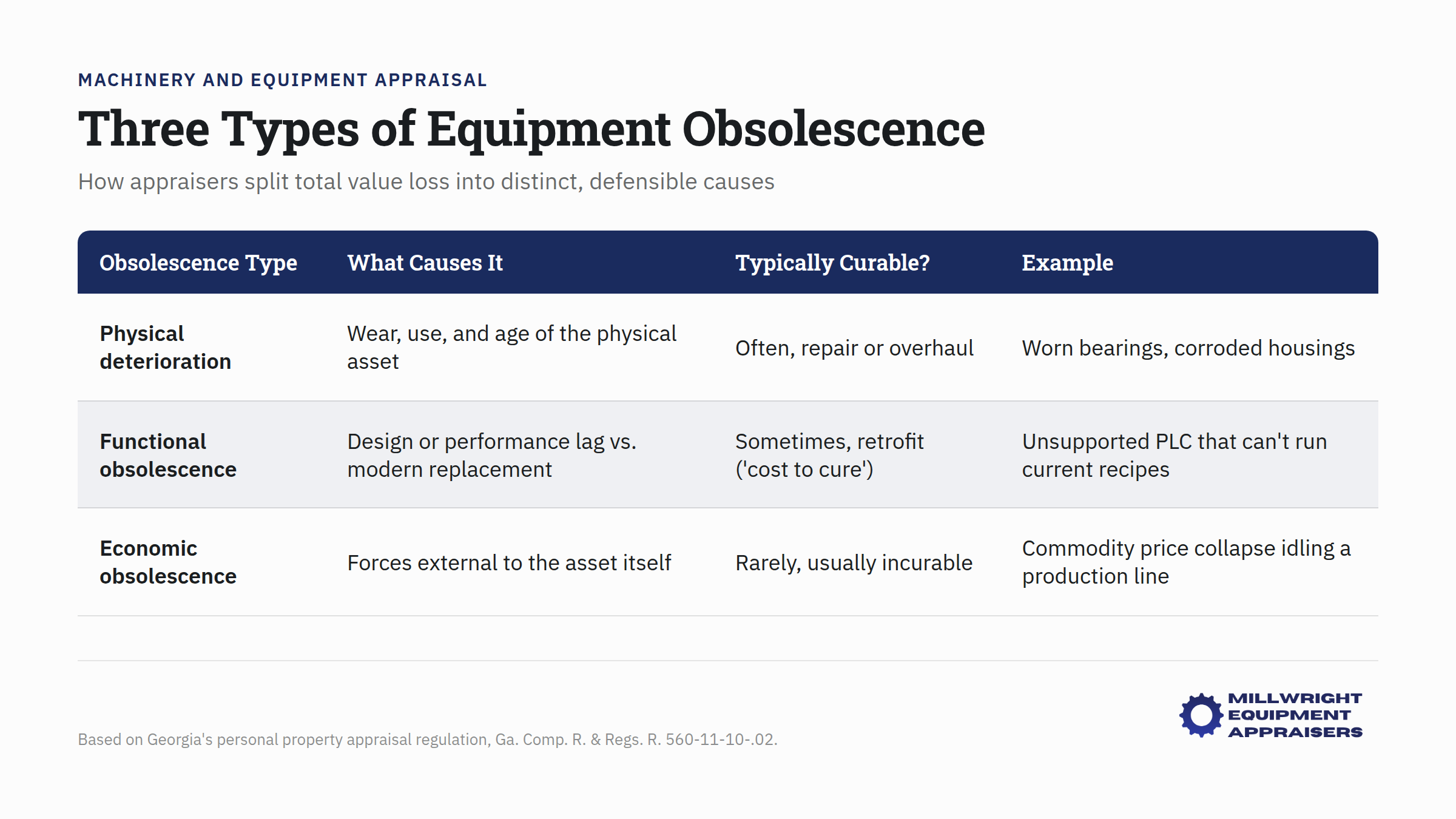
Equipment obsolescence appraisal is the practice of separating an asset's total loss in value into three distinct causes: physical deterioration, functional obsolescence, and economic obsolescence, rather than assuming age alone explains the gap between original cost and current worth. A ten-year-old machine can be mechanically flawless and still be worth a fraction of its depreciated book value because its design, its control platform, or the market it serves has moved on. Our machinery and equipment appraisal team treats these three categories separately in every cost approach analysis because lumping them together produces a number nobody can defend in an IRS filing, a loan file, or a courtroom.
State and federal property tax authorities use the same three-way split. Georgia's personal property appraisal regulation, for example, defines depreciation as covering physical deterioration, functional obsolescence, and economic obsolescence as separate, additive components of loss. The distinction matters because each type behaves differently, responds to different evidence, and gets cured (or not cured) in different ways.
| Obsolescence Type | What Causes It | Typically Curable? | Example |
|---|---|---|---|
| Physical deterioration | Wear, use, and age of the physical asset | Often, through repair or overhaul | Worn bearings, corroded housings |
| Functional obsolescence | Design or performance inadequacy versus a modern replacement | Sometimes, through retrofit ('cost to cure') | An unsupported PLC that can't run current recipes |
| Economic obsolescence | Forces external to the asset itself | Rarely; usually incurable | A commodity price collapse that idles a production line |
Functional Obsolescence: When Machinery Falls Behind a Modern Replacement
Functional obsolescence is the loss in value caused by inefficiencies or inadequacies in the equipment itself when measured against a more efficient or less costly replacement that newer technology has made available, a standard drawn from the American Society of Appraisers' technical literature on the cost approach. This is not about whether the machine still runs. It is about whether it still competes.
Common drivers of functional obsolescence in industrial equipment include:
- Excess capital cost: the machine cost more to build than a modern equivalent because of an outdated design approach.
- Excess operating cost: the machine consumes more labor, energy, or maintenance than a current-generation replacement to produce the same output.
- Inadequacy or over-capacity: the equipment's throughput no longer matches the production line's actual needs, in either direction.
- Lack of utility: the design limits what the equipment can produce, regardless of how well it is maintained.
Example: A CNC machining center from 2010 may still hold tolerance and run reliably, but if it requires two operators and a manual tool-change routine where a current model needs one operator and automated tool changing, that labor gap is functional obsolescence, not physical wear. An appraiser quantifies the dollar value of that gap, not just notes that the machine is "older."
Economic Obsolescence: External Forces That Erode Machinery Value
Economic obsolescence, sometimes called external obsolescence, comes from forces outside the machine entirely: shifting commodity prices, new regulation, contracting demand, or industry-wide overcapacity. California's Board of Equalization instructs appraisers to substantiate this category separately from physical and functional causes, treating it as its own line item in the depreciation analysis.
Georgia's regulation describes economic obsolescence as impairment from "changes in optimum use, legislative enactment that restricts or impairs productivity, and changes in supply and demand relationships," and it specifically notes that this type of loss is normally incurable. A press brake in perfect working order and free of any design flaw can still lose substantial value if the metal fabrication market it served has shrunk by a third, or if new emissions rules make the process it supports uneconomical.
Watch out: Appraisers sometimes back into an obsolescence figure by comparing a machine's book value to its actual resale price and calling the entire gap "economic obsolescence." That aggregate number usually contains unmeasured functional obsolescence too. Treating it as pure economic loss overstates one category and understates the other, which weakens the report's defensibility if it is ever challenged.
Why Age-Based Straight-Line Depreciation Understates the Loss
Straight-line depreciation schedules built for tax or accounting purposes assume value declines at a constant rate tied to age. That assumption ignores functional and economic obsolescence entirely, which is exactly why a depreciation schedule and a fair market value appraisal can produce very different numbers for the same asset. Our depreciation schedule guide covers how accounting depreciation and appraised value diverge in more detail.
A machine can be 60% depreciated on the books and still fetch strong resale value because it remains functionally current. The reverse is just as common: a machine with plenty of remaining book value can be functionally stranded because a control platform, a production process, or an entire market segment moved past it. Appraisers who rely only on age-based tables miss both directions of that error.
Key takeaway: Age tells you how long an asset has existed. Obsolescence analysis tells you whether it still competes and whether the market it serves still exists. An appraisal that only measures the first is not measuring value.
The Hidden Obsolescence Risk: Outdated PLCs, Firmware, and Software Licenses
Modern industrial equipment runs on more than steel and motors. Programmable logic controllers, human-machine interface panels, and proprietary software licenses now govern how a machine operates, and those digital layers create an obsolescence risk that a purely mechanical inspection will miss entirely.
Three failure points show up repeatedly in equipment appraisal assignments:
- Unsupported control platforms: a PLC or HMI running on a discontinued operating system that the manufacturer no longer patches, leaving the equipment unable to integrate with current plant networks or safety standards.
- Lapsed or non-transferable software licenses: control software, monitoring dashboards, or CAD/CAM packages tied to a license that does not transfer to a buyer, or that has lapsed and cannot be renewed on reasonable terms.
- Firmware that can't be updated: embedded firmware that has reached end-of-life support, meaning any failure in that component forces a full controller replacement rather than a simple patch.
Accounting standards generally treat installed software as an intangible asset, valued and depreciated separately from the physical machine it runs on rather than folded into the hardware's cost basis. In an appraisal context, that distinction matters less for classification and more for consequence: when embedded control software becomes an inadequacy relative to a modern equivalent, the loss is measured as functional obsolescence of the equipment, because the software's shortcomings directly limit what the machine can do in production.
Example: A packaging line with a mechanically sound conveyor and sealing system can still be functionally obsolete if its proprietary recipe-management software is no longer licensed for the current version and the vendor has discontinued support. The line runs, but it cannot be reconfigured for new products without a costly controls upgrade, which is precisely the kind of "cost to cure" an appraiser deducts from replacement cost new.
Pro tip: When scoping an equipment appraisal for controls-heavy machinery, gather license agreements, firmware version histories, and vendor support status alongside the usual maintenance logs. That documentation is often the difference between an appraiser estimating obsolescence and an appraiser proving it.
How Appraisers Quantify Remaining Useful Life
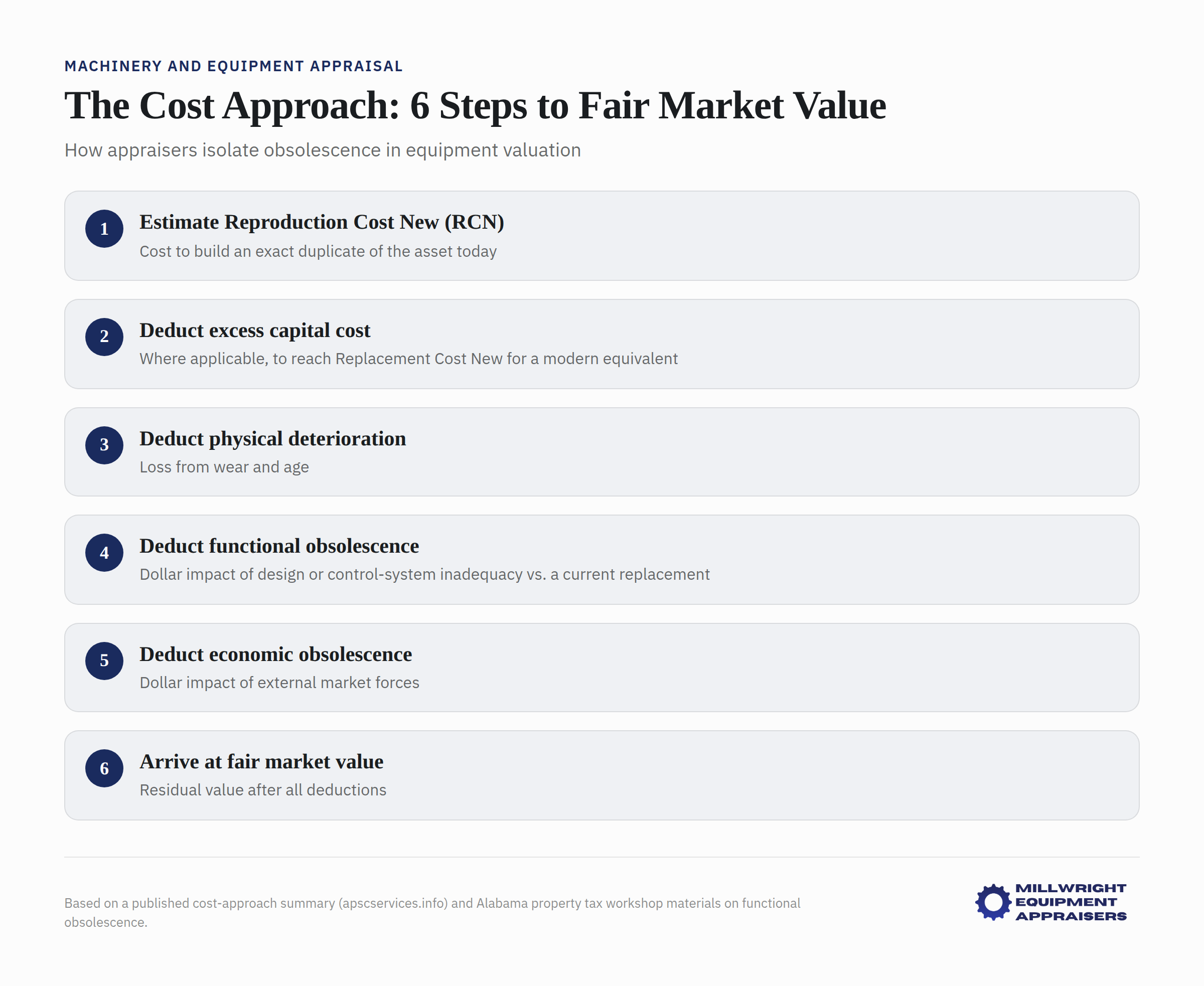
The cost approach isolates obsolescence through a defined sequence rather than a single blended discount. One published summary of the method used across regulatory and appraisal practice lays out the equation as follows:
- Estimate Reproduction Cost New (RCN): the cost to build an exact duplicate today.
- Deduct excess capital cost: where applicable, to reach Replacement Cost New, the cost of a modern equivalent with the same utility.
- Deduct physical deterioration: wear and age-related loss.
- Deduct functional obsolescence: the dollar impact of design or control-system inadequacy versus a current replacement.
- Deduct economic obsolescence: the dollar impact of external market forces.
- Arrive at fair market value: the residual after all three deductions.
Two methods do most of the work in steps 4 and 5. The cost-to-cure method prices out the specific fix (a controls retrofit, a firmware replacement, a license renewal) and treats that cost as the functional obsolescence deduction when the fix is economically justified. Where a straightforward cure doesn't exist, appraisers turn to an excess operating cost or capacity-based formula; public property tax workshop materials describe a functional obsolescence estimate built from the ratio of an asset's potential capacity to its current utilized capacity, with a larger utilization gap producing a larger obsolescence deduction. Economic obsolescence gets quantified in a parallel way, often through ratios of cost of goods sold to output capacity that capture reduced profitability relative to a plant's designed throughput.
Example: Suppose a stamping press has a Replacement Cost New of $500,000. Physical deterioration is measured at 20% ($100,000). The press's control system is two generations behind current models, and a controls retrofit that would bring it current is quoted at $60,000, so functional obsolescence is set at that cost-to-cure figure. No credible evidence of economic obsolescence exists for this asset's market segment. Fair market value would be roughly $500,000 minus $100,000 minus $60,000, or $340,000, a very different number than a straight-line schedule showing 60% remaining book value would suggest.
Credentials Behind a Defensible Equipment Obsolescence Appraisal
Quantifying three separate obsolescence categories, and tying software and controls risk to the right one, requires training that goes beyond a general business valuation background. Machinery and equipment appraisers typically hold credentials from organizations such as the ASA, CAGA, and NEBB (through its Certified Machinery & Equipment Appraiser designation), and every report should be prepared in accordance with USPAP, the standards maintained by The Appraisal Foundation.
Because scope, not asset value, drives the fee, engagements for machinery and equipment appraisal are quoted as a fixed fee once the assignment is scoped, covering standard reports from $295 and IRS-qualified reports from $395, with typical assignments running $695 to $3,000 and highly complex, multi-asset facility appraisals reaching $5,000 to $10,000 or more. These are fixed-fee engagements, quoted before work begins, never billed by the hour.
Getting Obsolescence Right Before It Costs You
A machine that still runs is not automatically a machine that still holds its book value. Functional and economic obsolescence, and increasingly the software and control systems layered on top of modern equipment, can strip value from an asset long before physical wear would predict it. Isolating each cause with cost-to-cure and excess operating cost analysis, rather than defaulting to a straight-line depreciation curve, is what turns an estimate into a report that holds up under IRS, lender, or courtroom scrutiny.
If your equipment includes aging control systems, licensed software, or a production role that has shifted in recent years, request an equipment appraisal scoped to identify exactly where that value has gone.
This article is provided for general informational purposes only and does not constitute legal, tax, or financial advice. Readers should consult a qualified attorney or CPA regarding their specific circumstances.