
Blog
Fair Market Value vs Orderly Liquidation Value vs Forced Liquidation Value: Which Applies to Your Equipment
Fair market value, orderly liquidation value, and forced liquidation value are three distinct premises, and picking the wrong one can misstate what your equipment is actually worth in a given transaction. This guide explains how each premise works and gives you a decision framework for matching the right value to a sale, a loan, or a distressed liquidation.
An equipment appraisal is only as useful as the value premise behind it. Ask an appraiser to value a fleet of CNC machines for an arm's-length sale and you'll get a different number than if you ask for the value that would support a lender's borrowing base or a bankruptcy trustee's liquidation plan. All three numbers can be correct; they're just answering different questions. Our machinery and equipment appraisal services start with this exact question, because the wrong premise produces a report that doesn't hold up for its intended use.
What Is Fair Market Value for Equipment?
Fair market value (FMV) is the price a piece of equipment would bring in a transaction between a willing buyer and a willing seller, with neither party under any compulsion to act and both having reasonable knowledge of the relevant facts. It's the baseline premise used across most tax, insurance, and financial reporting purposes, and it assumes normal market exposure with no rush on either side.
According to the American Society of Appraisers' definitions of value for machinery and technical specialties, fair market value assumes an orderly, unforced transaction where the seller has adequate time to find the right buyer. This is the premise most people picture when they think of an appraisal: what would this equipment actually sell for on the open market, given a reasonable amount of time to find a qualified buyer?
Example: A printing company selling a 5-year-old offset press to a competitor, with both sides negotiating freely and no deadline pressure, is a fair market value transaction.
What Is Orderly Liquidation Value?
Orderly liquidation value (OLV) is the gross amount a piece of equipment would likely bring in a liquidation sale, given a reasonable period to find a buyer, with the seller compelled to sell but not rushed. The seller is under some form of pressure, a loan default, a lease wind-down, a company restructuring, but the sale still happens through a properly managed process rather than an emergency auction.
Industry sources describe OLV as typically lower than fair market value because the seller's compulsion to sell removes some of the leverage a truly willing seller would have. BCAM Asset Management notes that OLV is commonly used in lending and distressed-transaction contexts precisely because it accounts for the frictions a normal sale doesn't: de-installation, transport, refurbishing, storage, and remarketing costs that a seller under time pressure has to absorb.
Example: A manufacturer winding down a product line sells its packaging equipment through a structured sale process over four to six months, with a broker actively marketing the assets. That's an orderly liquidation scenario, and OLV is the applicable premise.
For situations where an entire operation, not individual assets, is being wound down, our equipment appraisal services for bankruptcy and distressed sales are built around exactly this premise.
What Is Forced Liquidation Value?
Forced liquidation value (FLV) is the gross amount a piece of equipment would likely bring at a properly advertised public auction, with the seller compelled to sell immediately, on an as-is, where-is basis. There's no meaningful marketing runway here. The sale has to happen now, and the price reflects that urgency.
Industry guidance from the NEBB Institute frames the difference between orderly and forced liquidation almost entirely in terms of exposure time and the degree of compulsion on the seller. An auction can still occasionally produce prices close to fair market value if the equipment is in high demand and the auction is well attended, but it's a mistake to assume every auction result equals forced liquidation value. Each sale needs to be evaluated on its own circumstances.
Example: A court-ordered sheriff's sale of shop equipment following a judgment, conducted within 30 days through a single advertised auction, is a forced liquidation scenario.
The Compulsion-and-Exposure-Time Framework
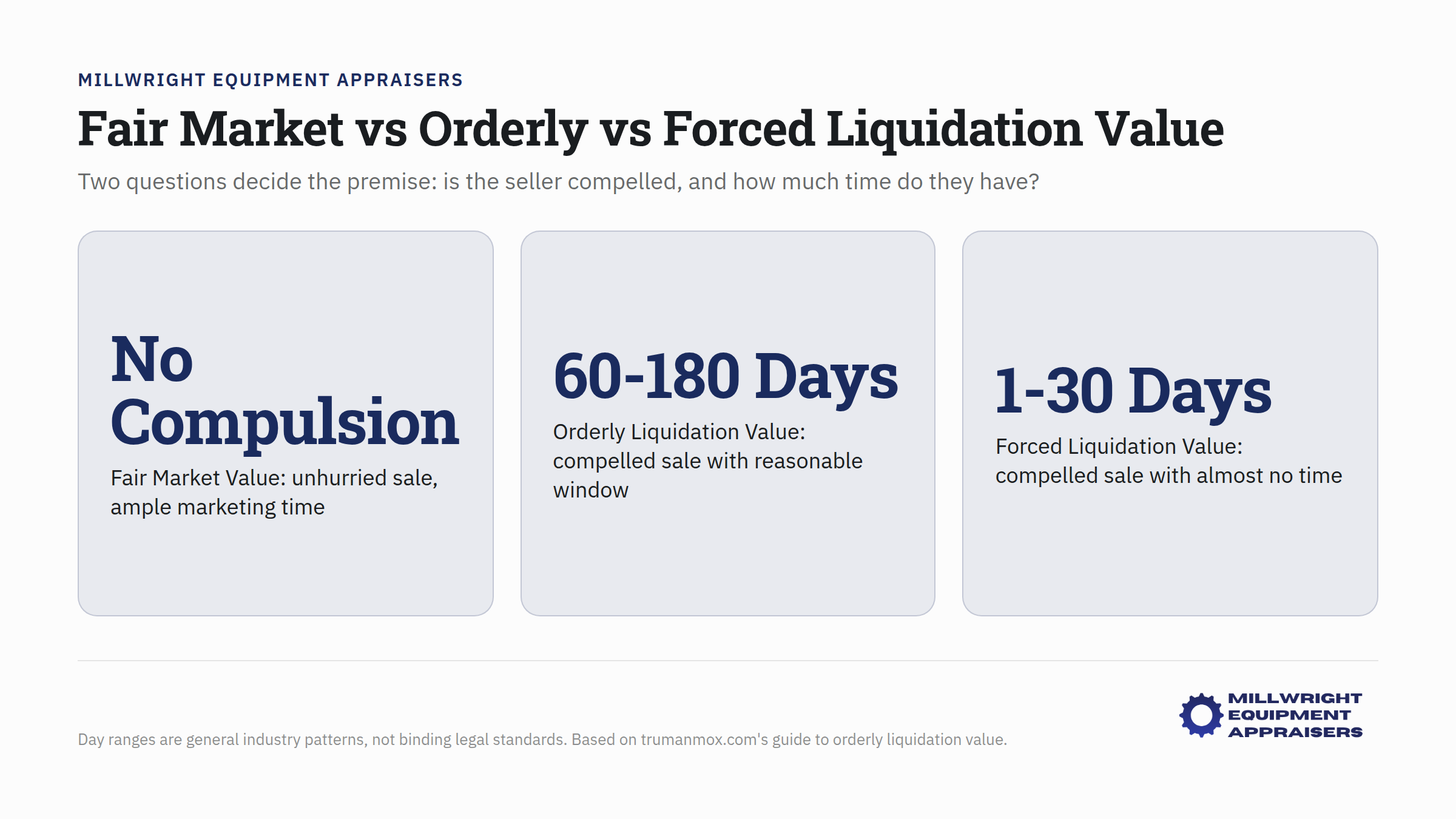
The fastest way to tell these three premises apart is to ask two questions: is the seller under compulsion to sell, and how much time do they have to market the asset? Fair market value assumes no compulsion and adequate time. Orderly liquidation value assumes compulsion but a reasonable marketing window. Forced liquidation value assumes compulsion and almost no time at all.
Some industry publications put rough numbers on that window: orderly liquidation sales are often described as taking place over roughly 60 to 180 days, while forced liquidation sales typically wrap up in 1 to 30 days. These aren't binding legal standards, they're general industry patterns, but they're a useful gut check when you're trying to figure out which premise fits your situation.
Watch out: Don't assume liquidation always means the lowest possible number. A nearly-new, in-demand asset sold in a strong market can see very little difference between fair market value and orderly liquidation value. It's older equipment in a soft market where the gap widens, sometimes substantially.
Comparing the Three Value Premises
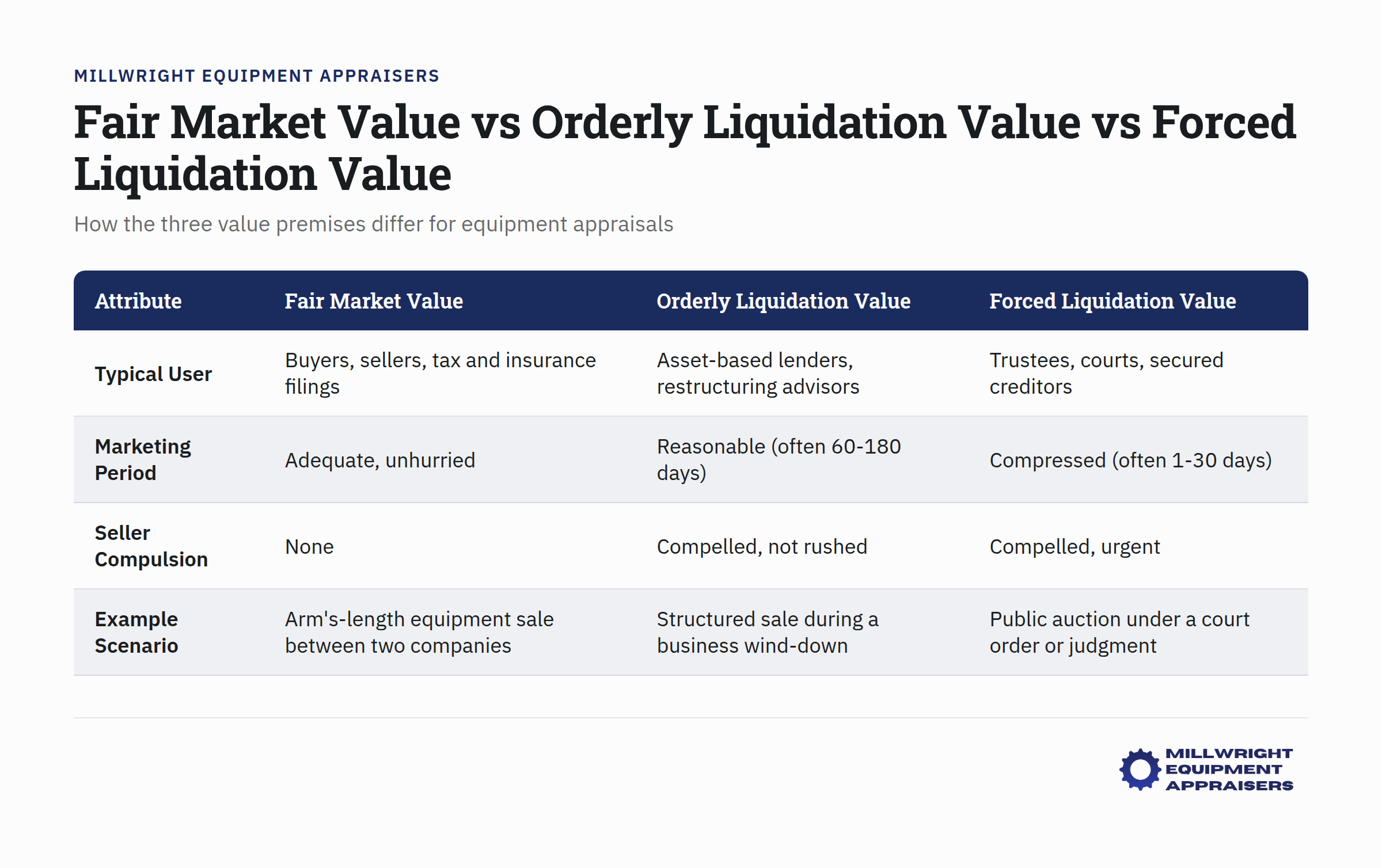
The table below summarizes how each premise differs in terms of who typically relies on it, how much time is assumed for the sale, the level of compulsion on the seller, and a representative scenario.
| Value Premise | Typical User | Marketing Period | Seller Compulsion | Example Scenario |
|---|---|---|---|---|
| Fair Market Value | Buyers, sellers, tax and insurance filings | Adequate, unhurried | None | Arm's-length equipment sale between two companies |
| Orderly Liquidation Value | Asset-based lenders, restructuring advisors | Reasonable (often 60-180 days) | Compelled, not rushed | Structured sale during a business wind-down |
| Forced Liquidation Value | Trustees, courts, secured creditors | Compressed (often 1-30 days) | Compelled, urgent | Public auction under a court order or judgment |
Which Value Premise Applies to Your Situation?
The right premise depends entirely on why the appraisal exists, not on what the equipment happens to be. Matching the premise to the purpose is the single most important decision in scoping an equipment appraisal.
- An arm's-length sale or purchase between two parties: Fair market value applies. Both sides have time to negotiate and neither is under pressure to close quickly.
- A loan review or asset-based lending borrowing base: Orderly liquidation value is the standard premise. Lenders need a realistic estimate of what they could recover if they had to liquidate the collateral in a compelled but non-emergency sale.
- A bankruptcy filing or distress sale: Depending on the timeline the court or trustee sets, this can call for either orderly liquidation value or forced liquidation value. A Chapter 11 reorganization with a structured asset sale often supports OLV; a Chapter 7 liquidation on a tight court deadline often calls for FLV.
- A court-ordered liquidation or sheriff's sale: Forced liquidation value applies, since the sale has to happen within a fixed, compressed window regardless of market conditions.
Pro tip: If you're not sure which premise a lender, court, or counterparty expects, ask before the appraisal is scoped. Reworking a report from one premise to another after the fact costs more time and money than getting the scope right up front.
Why Asset-Based Lenders Lean on Orderly Liquidation Value
Lenders extending credit against equipment collateral commonly set their advance rates against orderly liquidation value, or net orderly liquidation value after estimated sale costs, rather than fair market value. This is standard industry practice, not a rule specific to any one appraisal firm. EquipmentWatch's resource on OLV explains that lenders favor OLV because it reflects a more realistic recovery scenario if the borrower defaults and the collateral has to be sold under time pressure, rather than the price it might fetch in an unhurried, freely negotiated sale.
That's an important distinction for equipment owners negotiating financing. A machine with a strong fair market value doesn't automatically translate into an equally strong borrowing base, because the lender is pricing risk around a compelled-sale outcome, not a best-case sale outcome.
Key takeaway: Fair market value, orderly liquidation value, and forced liquidation value are not three ways of measuring the same thing; they're answers to three different questions about how, and how fast, an asset would need to sell. Getting the premise right at the start of an engagement is what makes the resulting number useful for its intended purpose, whether that's a sale, a loan, a bankruptcy filing, or a court-ordered liquidation.
Getting the Right Premise From the Start
Our appraisers hold credentials with organizations such as the ASA, CAGA, and NEBB, and every engagement is prepared in accordance with USPAP regardless of which value premise applies. Before any inspection begins, we confirm the intended use of the report, the party relying on it, and the compulsion and timeline behind the transaction, because that combination is what determines whether fair market value, orderly liquidation value, or forced liquidation value is the correct premise. If you're facing a lender review, a distressed sale, or a court deadline and aren't sure which number you need, our equipment appraisal services for bankruptcy and distressed sales team can help scope the assignment correctly the first time.
This article is provided for general informational purposes only and does not constitute legal, tax, or financial advice. Readers should consult a qualified attorney or financial advisor regarding their specific circumstances.