
Blog
IRS Form 8283 and the $5,000 Threshold for Equipment Donation Appraisals
Donating equipment worth more than $5,000 to a qualified charity generally requires a signed IRS Form 8283 and a qualified appraisal to support the deduction. This guide walks through the threshold, the appraisal timing rules, and what happens if the paperwork is incomplete.
Donating used machinery, vehicles, or shop equipment to a school, fire department, or nonprofit is a generous move, but the IRS wants proof of what you're claiming. Once the deduction for a piece of equipment (or a group of similar items) tops $5,000, the rules shift from a simple description on your return to a formal appraisal summary signed by three separate parties. Get a step wrong and the IRS can disallow the entire deduction, not just trim it.
This guide breaks down exactly when Form 8283 applies to equipment donations, what Section B requires, and how the timing rules for a qualified appraisal actually work. If you're weighing a donation of a forklift, generator, CNC machine, or other business equipment, our equipment appraisal for charitable donation service is built around this exact substantiation chain.
What Triggers IRS Form 8283 for Donated Equipment?
Any taxpayer, individual, partnership, or corporation, claiming a deduction of more than $500 for all noncash charitable contributions in a tax year must file Form 8283. Equipment donations fall under this rule the same way clothing, art, or collectibles do: the IRS treats machinery and equipment as tangible personal property, valued at fair market value on the date of the gift.
Most donors first hit the $500 line and file Section A of the form. It's the $5,000 mark that changes everything.
The $5,000 Threshold: Section A vs. Section B
When the claimed deduction for a single piece of equipment, or for a group of similar equipment items, exceeds $5,000, the donor moves from Section A to Section B of Form 8283. Section B is often called the "appraisal summary," and that name matters: it summarizes the qualified appraisal, it is not the appraisal report itself.
Section B requires signatures from three parties: the donor, the qualified appraiser who valued the equipment, and the donee organization acknowledging receipt. The Form 8283 instructions spell out exactly which fields each party completes, and the donee's signature in Part V confirms only that the organization received the described property, not that it agrees with the appraised value.
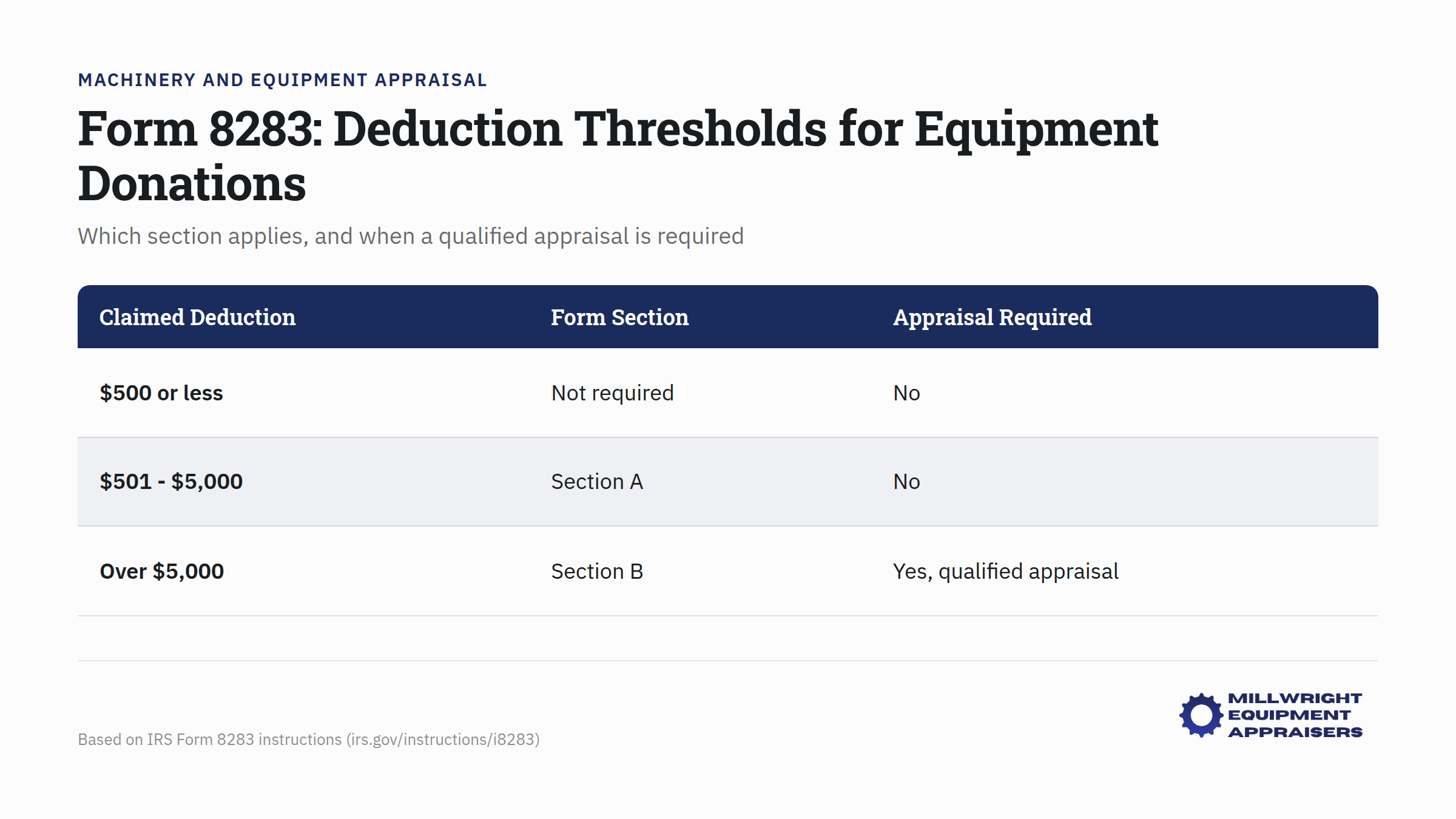
| Claimed Deduction | Form Section | Appraisal Required |
|---|---|---|
| $500 or less | Not required | No |
| $501 - $5,000 | Section A | No |
| Over $5,000 | Section B | Yes, qualified appraisal |
What Counts as a Qualified Appraisal for Equipment?
A qualified appraisal is a valuation report prepared by a qualified appraiser that documents fair market value using an accepted methodology, not a dealer quote or a auction estimate. For equipment, that typically means analyzing comparable sales, replacement cost, and remaining useful life to arrive at a defensible number.
Appraisals are not necessary when the claimed deduction for an item or group of similar items is $5,000 or less. Above that line, Publication 561 sets out what the appraisal must contain: a description of the equipment, its physical condition, the date of contribution, the valuation date, and the specific method used to determine value.
Watch out: A sales brochure, a dealer's trade-in offer, or an online marketplace listing does not satisfy the qualified appraisal requirement. The IRS is looking for an independent, methodology-driven report from someone with verifiable credentials in valuing that type of asset.
When Must the Qualified Appraisal Be Completed?
Contrary to a common assumption, the appraisal does not need to exist before or at the moment you hand over the equipment. Per IRS guidance on Publication 561, a qualified appraisal must be completed no later than the due date, including extensions, of the tax return on which the deduction is first claimed. If the deduction shows up instead on an amended return, the appraisal must be finished before that amended return is filed.
Example: A business donates a used industrial press in November and files its return the following April with a filing extension to October. The equipment appraisal can be completed any time between the donation date and that October deadline and still satisfy the requirement.
Generally, the appraisal report itself is not attached to the return. The donor keeps a copy in their records and attaches only the completed Form 8283. Equipment donations do not fall under the narrow exceptions (like art gifts of $20,000 or more) that require the full appraisal to be filed with the IRS.
The Similar Items Rule and Grouping Equipment
A separate qualified appraisal and a separate Form 8283 are generally required for each item of donated property. The exception is a group of similar items: equipment of the same generic category, such as a set of shop tools or a fleet of matching forklifts, can be covered by one appraisal if that appraisal includes all the required information for each item and everything was contributed in the same tax year.
This grouping rule cuts both ways. If a donor gives several pieces of equipment that individually fall under $5,000 but are similar to one another, the IRS aggregates them. Once the combined claimed value of the group exceeds $5,000, the appraisal and Section B requirements apply to the whole group, even though no single item crossed the line on its own.
Pro tip: Before donating multiple pieces of related equipment across the same tax year, total the expected fair market value first. Splitting a group across donees or reporting periods does not avoid the aggregation rule.
What Happens If You Skip the Appraisal or Form 8283?
If a deduction over $5,000 is not properly substantiated, meaning Form 8283 isn't attached or Section B isn't fully completed, the IRS can disallow the deduction outright. There's a narrow reasonable-cause exception for failures that weren't due to willful neglect, but that's not a safety net a taxpayer should count on. Courts and the IRS have historically applied it sparingly, and it does not excuse skipping the appraisal itself.
This is the practical reason to treat the appraisal as part of the donation process, not an afterthought handled after an audit letter arrives. An equipment appraisal prepared in accordance with recognized valuation standards gives the donor a defensible number and a paper trail that matches what Section B requires.
Donee Reporting: Form 8282 and the Three-Year Rule
The substantiation chain doesn't end when the donee signs Form 8283. If the receiving organization sells, trades, or otherwise disposes of the donated equipment within three years of receiving it, the donee must file Form 8282, Donee Information Return, with the IRS and send a copy to the donor. This lets the IRS compare the sale price against the value the donor originally claimed.
Donors have no control over what a charity does with equipment after the gift, but it's worth knowing this reporting trigger exists, especially for higher-value machinery that a nonprofit might liquidate quickly for cash rather than put into service.
Who Can Sign Off as a Qualified Appraiser?
The IRS defines a qualified appraiser as someone who has earned an appraisal designation from a recognized professional organization or otherwise met minimum education and experience requirements for the type of property being valued, and who regularly performs appraisals for compensation. For equipment and machinery, that generally means an appraiser holding credentials such as ASA, CAGA, or NEBB's Certified Machinery & Equipment Appraiser (CMEA) designation, working to standards set out by The Appraisal Foundation and USPAP (the Uniform Standards of Professional Appraisal Practice).
An appraiser also cannot have a disqualifying relationship with the donor or the donee, and cannot be paid based on a percentage of the appraised value. Both restrictions exist to keep the valuation independent.
Planning an Equipment Donation the Right Way
The $5,000 threshold is the line that separates a straightforward tax deduction from one that requires a qualified appraisal, a completed Section B, and three signatures. Missing any piece of that chain puts the whole deduction at risk, not just the portion above $5,000.
Our team scopes equipment donation appraisals as a fixed fee after reviewing the equipment type, quantity, and intended use of the report, never as an hourly engagement. If you're planning to donate machinery, vehicles, or shop equipment and need a report that supports Section B of Form 8283, our equipment appraisal for charitable donation service can help you get the substantiation right before the return is filed.
This article is provided for general informational purposes only and does not constitute legal, tax, or financial advice. Readers should consult a qualified attorney or CPA regarding their specific circumstances.