
Blog
How Insurers Use Salvage Value to Settle Heavy Equipment Total Loss Claims
When a carrier declares your excavator, truck, or processing line a total loss, salvage value is the number that quietly shrinks your check. This guide walks through the settlement formula, how adjusters arrive at that figure, and how an independent appraisal can push back on it.
When heavy equipment is damaged beyond economical repair, the insurance payout almost never equals the machine's pre-loss value. Carriers subtract salvage value first, and that single line item can swing a settlement by tens of thousands of dollars. Owners who understand how salvage value gets calculated, and who are willing to challenge it with their own data, generally recover more than owners who simply accept the number on the adjuster's worksheet.
If you're currently disputing a figure on an open claim, our equipment appraisal for insurance claim service exists for exactly this situation: an independent, USPAP-compliant valuation that stands on its own in a negotiation or a formal dispute.
What Is Salvage Value in an Equipment Insurance Claim?
Salvage value is the amount a damaged machine is still worth after a loss, sold as-is to a salvage buyer, dismantler, or auction house. It is distinct from scrap value (melted-down material worth) and from part-out value (worth of individual usable components). Insurers subtract salvage value from a total loss settlement because, in theory, the owner (or the insurer, if it takes possession) can still recover that money by selling the wreck.
The term shows up across tax, accounting, and insurance contexts with slightly different mechanics, but the core idea stays consistent: it's the residual value of an asset that no longer functions as originally intended (general industry guidance on salvage value). For equipment owners, the practical question is simpler: how much is your carrier deducting, and can you prove that number is wrong?
The Total Loss Settlement Formula for Heavy Equipment
The standard formula insurers use to settle a total loss claim on commercial equipment is:
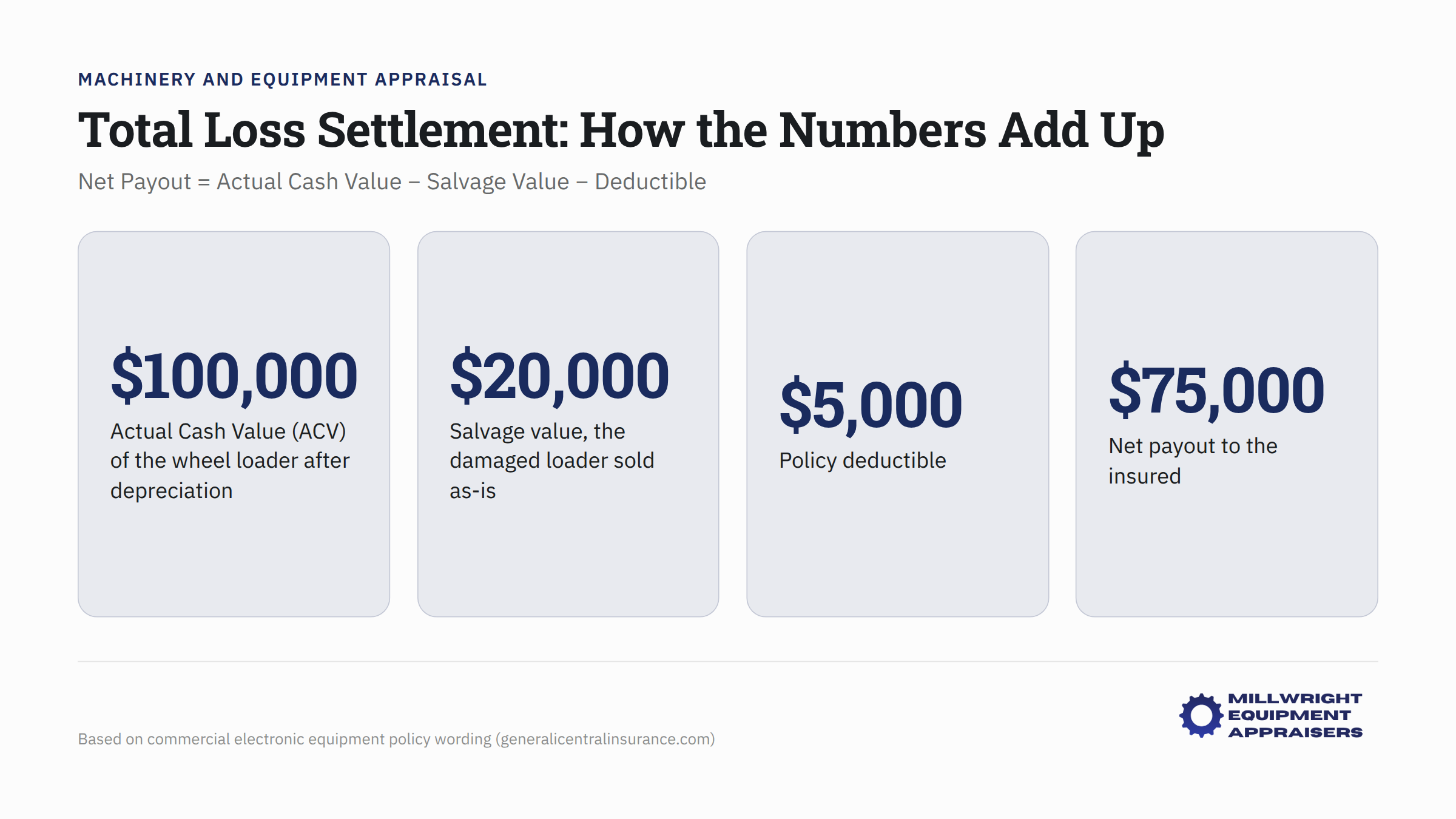
Net Payout = Actual Cash Value (ACV) minus Salvage Value minus Deductible
Actual cash value is typically calculated as replacement cost new, less appropriate depreciation for age, hours, condition, and obsolescence. Replacement cost itself is the cost to replace the machine with one of similar quality, capacity, and condition within a reasonable time in the relevant market, not simply the sticker price of a new unit. Commercial equipment policy wordings describe this directly: destroyed property is settled at its value immediately before the loss, calculated by deducting depreciation from replacement value, with salvage factored into the final number (commercial electronic equipment policy wording).
Example: A mid-size wheel loader has an actual cash value of $100,000 after depreciation. The adjuster values the salvage, the damaged loader sold as-is, at $20,000. The policy carries a $5,000 deductible. The math runs: $100,000 minus $20,000 minus $5,000, for a net payout of $75,000.
That $20,000 salvage figure is the most negotiable number in the whole equation, and it's worth understanding exactly how it gets produced.
How Adjusters Determine Salvage Value
Adjusters typically establish salvage value by soliciting bids from salvage buyers, equipment dealers, or auction houses for the damaged unit in its current, as-is condition. Rather than appraising the machine themselves, they're pricing what someone would actually pay to haul it away and resell or part it out.
That process draws on several inputs:
- Direct offers from salvage dealers or dismantlers familiar with the make and model.
- Comparable sales of similarly damaged units at auction.
- Scrap metal rates, if the machine has no resale value as a unit.
- Part-recovery value, when specific components (engines, transmissions, hydraulics) remain usable.
- Costs the insurer expects to deduct from gross salvage, such as transportation, dismantling, storage, and disposal.
Missouri's insurance regulator has described what a defensible valuation file should contain: adjustments that are itemized, measurable, verifiable, and supported by documentation, not a single unexplained number dropped into a settlement letter (Missouri Department of Commerce and Insurance market conduct materials). A commercial plant-and-machinery policy wording similarly frames a total loss settlement as actual value less salvage, with repair costs evaluated against that same pre-loss value before a total loss is even declared (plant and machinery insurance policy description).
Why Two Insurers Can Land on Different Numbers for the Same Machine
Salvage valuation is not standardized across the industry. One carrier's internal salvage database might price a damaged dozer at $18,000 based on recent regional auction results, while another carrier, using a different salvage network or a broader geographic pool of bids, lands on $26,000 for the identical machine. Neither number is necessarily wrong; they simply reflect different data sets, different assumed buyer pools, and different assumptions about dismantling and transport cost. That variability is exactly why owners shouldn't treat a single adjuster's salvage figure as the final word.
You Are Not Obligated to Accept the Insurer's Salvage Figure
This is the part most owners don't realize: the salvage figure on your settlement worksheet is a proposal, not a fact. You have standing to ask the adjuster for the specific bids, auction comparables, or methodology behind the number, and to present your own evidence if it doesn't hold up.
That evidence typically includes:
- An independent appraisal of the damaged unit's actual as-is salvage value, grounded in real buyer activity for that asset class.
- Documented offers from salvage buyers or dealers you've contacted directly.
- Evidence that the insurer's comparable sales involved a different condition, configuration, or region than your machine.
- A corrected pre-loss ACV, if the insurer's depreciation assumptions understated what the equipment was actually worth before the loss.
An independent appraisal doesn't just challenge the salvage deduction. It can also push back on an inflated repair-cost estimate the insurer used to justify declaring a total loss in the first place, or correct an understated pre-loss ACV that shrank the baseline before salvage was even subtracted. All three disputes turn on the same thing: having a defensible number of your own.
The Appraisal Clause: Resolving Valuation Disputes Without Litigation
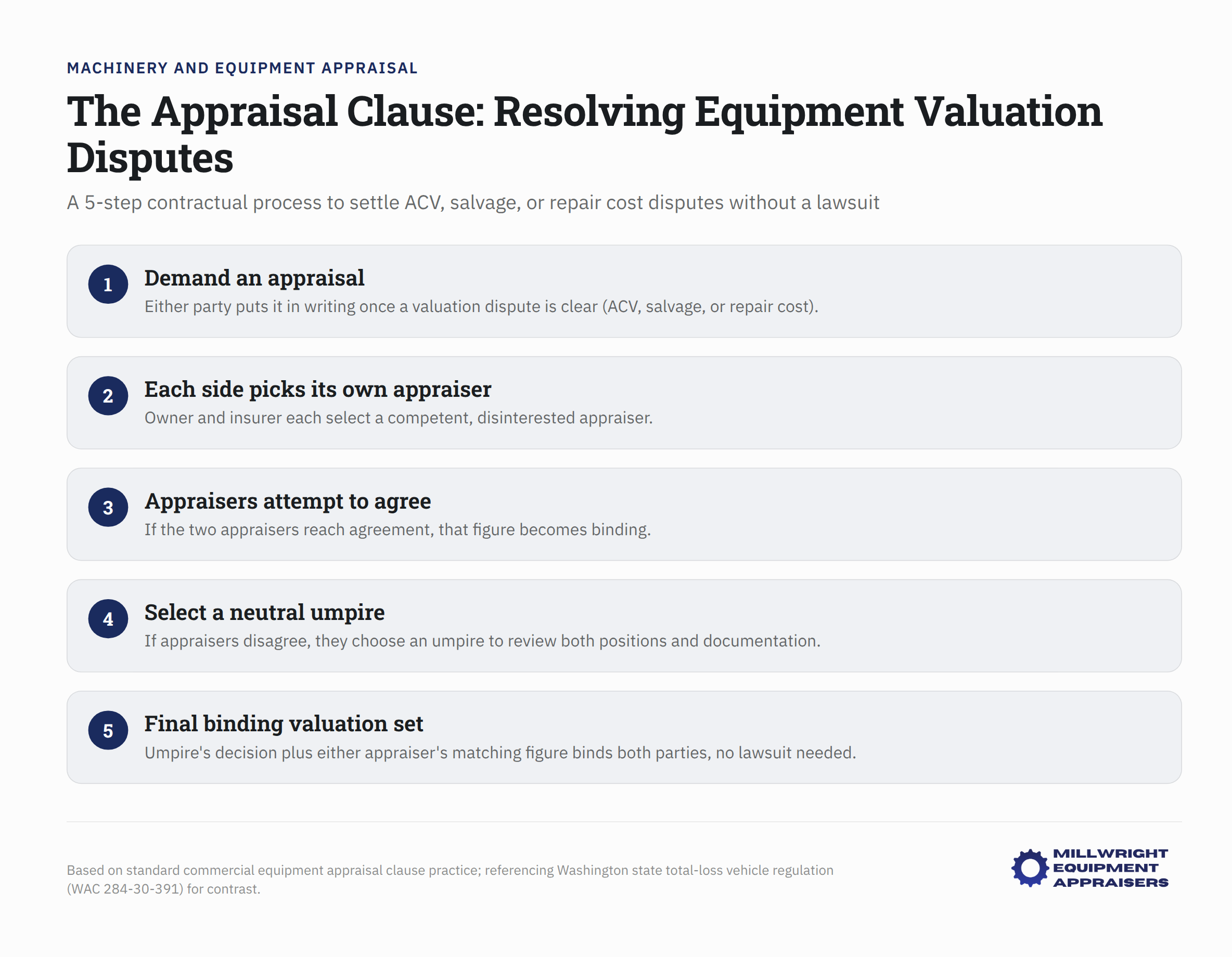
Most commercial property and equipment policies include an appraisal clause, a contractual mechanism built specifically for disagreements over the amount of loss. It's important to understand what this clause does and does not cover: it resolves disputes over value (what the ACV, salvage, or repair cost should be), not disputes over coverage (whether the loss is covered at all).
The process generally works like this:
- Either party demands an appraisal, in writing, once a valuation dispute is clear. This is usually triggered after the insurer and the owner can't agree on ACV, salvage value, or repair cost.
- Each side selects its own competent, disinterested appraiser. The owner's appraiser works for the owner; the insurer's appraiser works for the insurer.
- The two appraisers attempt to agree on the disputed value. If they reach agreement, that figure becomes binding.
- If they disagree, they select a neutral umpire. The umpire reviews both positions and the supporting documentation.
- The umpire's decision, combined with either appraiser's matching figure, sets the final valuation. This binds both parties on the amount of loss, without a lawsuit.
This process exists because insurance valuation disputes are common and genuinely technical. Regulators overseeing vehicle total-loss rules have pushed insurers toward similar transparency requirements, including itemized explanations of every addition and deduction to value (Washington state total-loss vehicle regulation). Commercial equipment doesn't fall under those same vehicle-specific statutes, which is exactly why a contractual appraisal clause, and your own independent appraiser, matters so much more for machinery claims.
Where an Independent Equipment Appraisal Protects Your Payout
The appraisal clause only works in your favor if your appraiser's number is defensible. That means grounding the valuation in the same cost approach framework insurers use: replacement cost new, adjusted for depreciation, age, hours, and condition, to establish ACV, and separately supported comparable sales or buyer bids to establish salvage value. Our breakdown of replacement cost value versus fair market value for insurance goes deeper into how these two figures diverge and why the distinction matters when you're negotiating a settlement.
An independent appraisal for a total-loss dispute is quoted as a fixed fee, scoped to the complexity of the unit and the depth of analysis required, never billed hourly and never priced off the claim's dollar value. For a single piece of heavy equipment, that typically starts in the low hundreds and scales with the number of units and the documentation involved.
Key takeaway: The salvage deduction is negotiable, not fixed. Before you sign a release on a total loss settlement, get the adjuster's methodology in writing and weigh it against an independent valuation of your own.
If you're facing a disputed salvage figure, an inflated repair estimate, or an ACV that doesn't match what your equipment was actually worth, our appraisers can prepare a standalone report built to support your position in negotiation or through a formal appraisal clause demand. Start with our equipment appraisal for insurance claim service to scope your assignment.
This article is provided for general informational purposes only and does not constitute legal, tax, or financial advice. Readers should consult a qualified attorney or insurance professional regarding their specific policy and claim.