
Blog
How an Equipment Appraisal for SBA Loans Strengthens Your Financing Application
An equipment appraisal for an SBA loan converts machinery on a depreciation schedule into a defensible collateral number lenders can actually underwrite against. This guide walks through the SOP thresholds, the book value vs. orderly liquidation value gap, and what a compliant report needs to include.
Why Lenders Need an Independent Equipment Appraisal for SBA Loans
When machinery and equipment are pledged as collateral for an SBA-backed loan, the number that matters most isn't the one sitting on the borrower's balance sheet. It's the number an independent appraiser assigns after physically inspecting the equipment. An equipment appraisal for an SBA loan gives lenders and Certified Development Companies (CDCs) a defensible, market-based value they can plug into collateral coverage tests, structure the loan amount around, and use to satisfy SBA Standard Operating Procedure (SOP) requirements. This guide walks through when SBA rules require that appraisal, why lenders discount the borrower's own depreciation schedule, and what a compliant collateral report has to contain.
When Does SBA SOP Require an Independent Equipment Appraisal?
SBA SOP requires an independent equipment appraisal whenever a lender wants to claim a fixed-asset value above net book value, and it sets specific collateral rules for machinery and equipment pledged on 7(a) and 504 loans.
Current SOP guidance states that if a lender's valuation of fixed assets, including machinery and equipment, is claimed above net book value, the lender must obtain an independent appraisal from a qualified individual to support that higher figure. That single rule is the reason most SBA-backed acquisitions and refinancings involving equipment end up ordering a third-party appraisal rather than relying on the seller's asset list.
A few common triggers show up repeatedly in SBA financing:
- Fixed-asset value above net book value: The lender is asserting the equipment is worth more than its depreciated accounting figure, which by itself is not enough support for underwriting.
- Used or existing equipment pledged as primary collateral: SOP applies specific caps to how much of that value can count toward loan security (covered below).
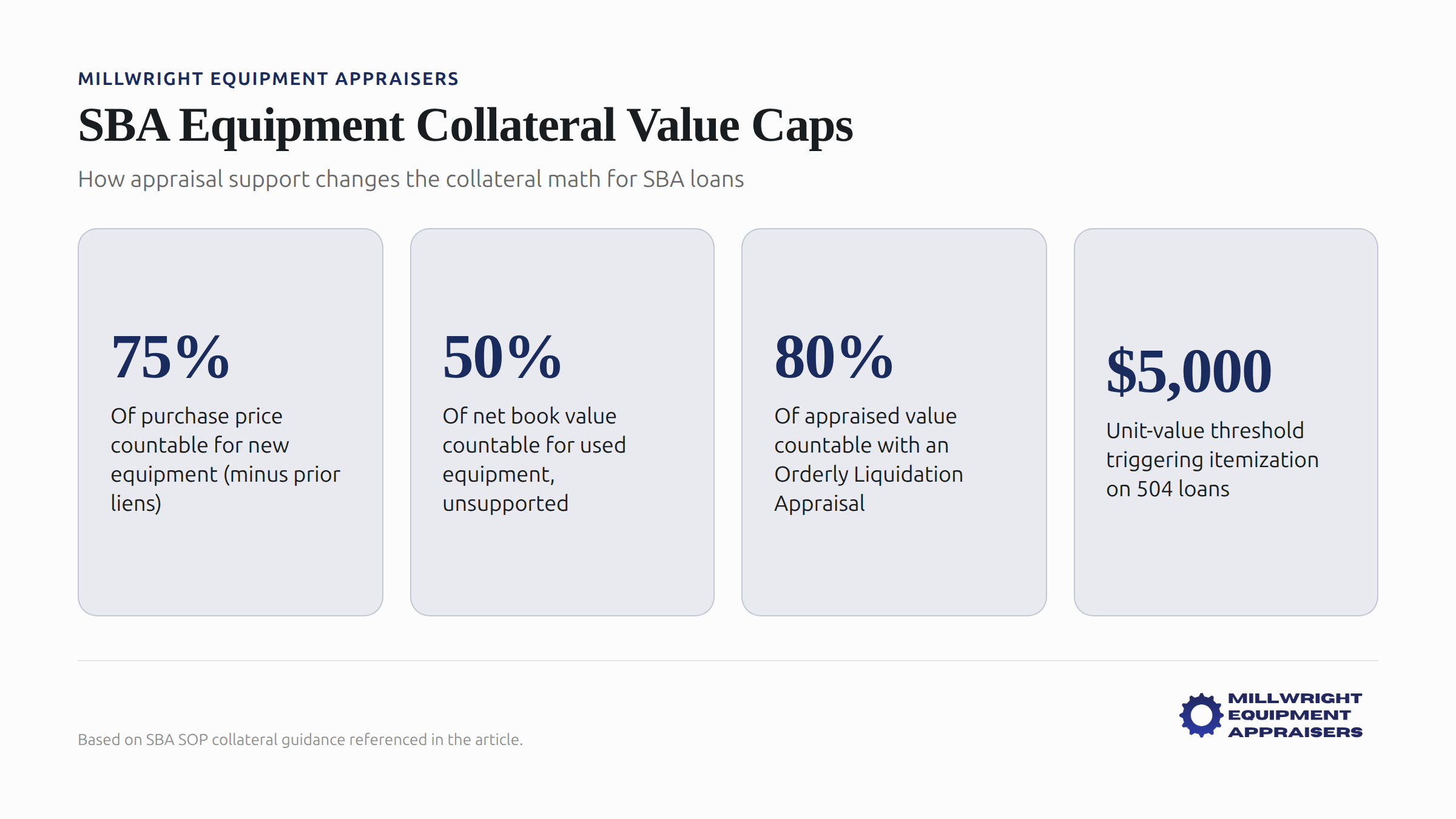
- 504 loans with equipment or fixtures as collateral: The CDC must obtain an itemized list of equipment and fixtures with unit values of $5,000 or more, which in practice means an appraiser has to identify and value each qualifying item individually rather than accepting a lump-sum estimate, per SBA 504 appraisal guidelines.
- Related-party transactions or substantial refinancing: Family buyouts, partner buyouts, and re-pledged collateral all raise the independence bar.
For context, SBA rules also set a commonly cited $500,000 threshold above which an appraisal is required for commercial real property. That figure is specific to real estate and shouldn't be conflated with the equipment collateral rules above, but it does illustrate that SBA builds appraisal thresholds into nearly every collateral category, not just real estate.
Book Value vs. Appraised Fair Market Value: Why Lenders Don't Trust the Balance Sheet
Book value is an accounting figure: original purchase price minus accumulated depreciation, calculated on a fixed schedule that has nothing to do with what the equipment could actually sell for. Appraised fair market value, or the orderly liquidation value a lender typically wants for collateral, is a market-based estimate built from inspection, comparable sales, and condition assessment. The two numbers routinely diverge, sometimes by a wide margin in either direction.
A five-year-old CNC machine might carry a net book value of $40,000 under an accelerated depreciation schedule while still commanding $90,000 or more on the used-equipment market, because tax depreciation is designed to shelter income, not to track resale value. The reverse also happens: specialized equipment with a niche buyer pool can be worth far less than its book value once a lender has to consider how quickly it would actually sell. Borrowers who track equipment value primarily for tax purposes can find that useful background for equipment appraisal for financial reporting purposes, but lenders won't underwrite against it directly.
Lenders anchor collateral decisions to the independent appraisal rather than the balance sheet for a simple reason: the borrower (and often the seller) has an incentive to state the higher number. An arm's-length appraiser has no stake in the transaction's outcome, which is exactly the defensibility SBA SOP is designed to require.
What Standard of Value Do Banks Want for Equipment Collateral?
Banks and CDCs typically want orderly liquidation value (OLV) for equipment collateral, because it reflects a realistic recovery scenario if the lender ever had to sell the equipment, rather than a hypothetical open-market sale with no time pressure.
OLV assumes the equipment is sold within a reasonable marketing period, commonly 6 to 12 months, which is a very different scenario from fair market value (an unhurried sale between a willing buyer and seller with no compulsion) or forced liquidation value (an auction-style sale under severe time pressure, typically 30 to 90 days). For a deeper breakdown of how these three premises differ and when each applies, see our guide to fair market value vs. orderly liquidation value vs. forced liquidation value. For SBA collateral purposes, the distinction matters because SOP explicitly ties higher collateral credit to an Orderly Liquidation Appraisal (OLA), not to a fair market value opinion.
SBA Collateral Value Caps: The Key Percentage Rules
SBA SOP sets specific ceilings on how much equipment value counts toward loan security, and those ceilings shift depending on whether the appraisal supports the number.
For new machinery and equipment, SOP allows lenders to count up to 75% of the purchase price, minus any prior liens, toward collateral coverage. For used or existing equipment, the cap drops to 50% of net book value, or as high as 80% of appraised value if that value is supported by an Orderly Liquidation Appraisal, again net of prior liens. That 30-point spread between the unsupported and appraisal-backed figures is often the difference between a loan that clears SBA's fully-secured test and one that requires additional equity injection or extra collateral.
Worked Example: Book Value vs. Orderly Liquidation Value for a CNC Machine
Here's an illustrative example (not a real client engagement) showing why the appraisal, not the depreciation schedule, drives the collateral math.
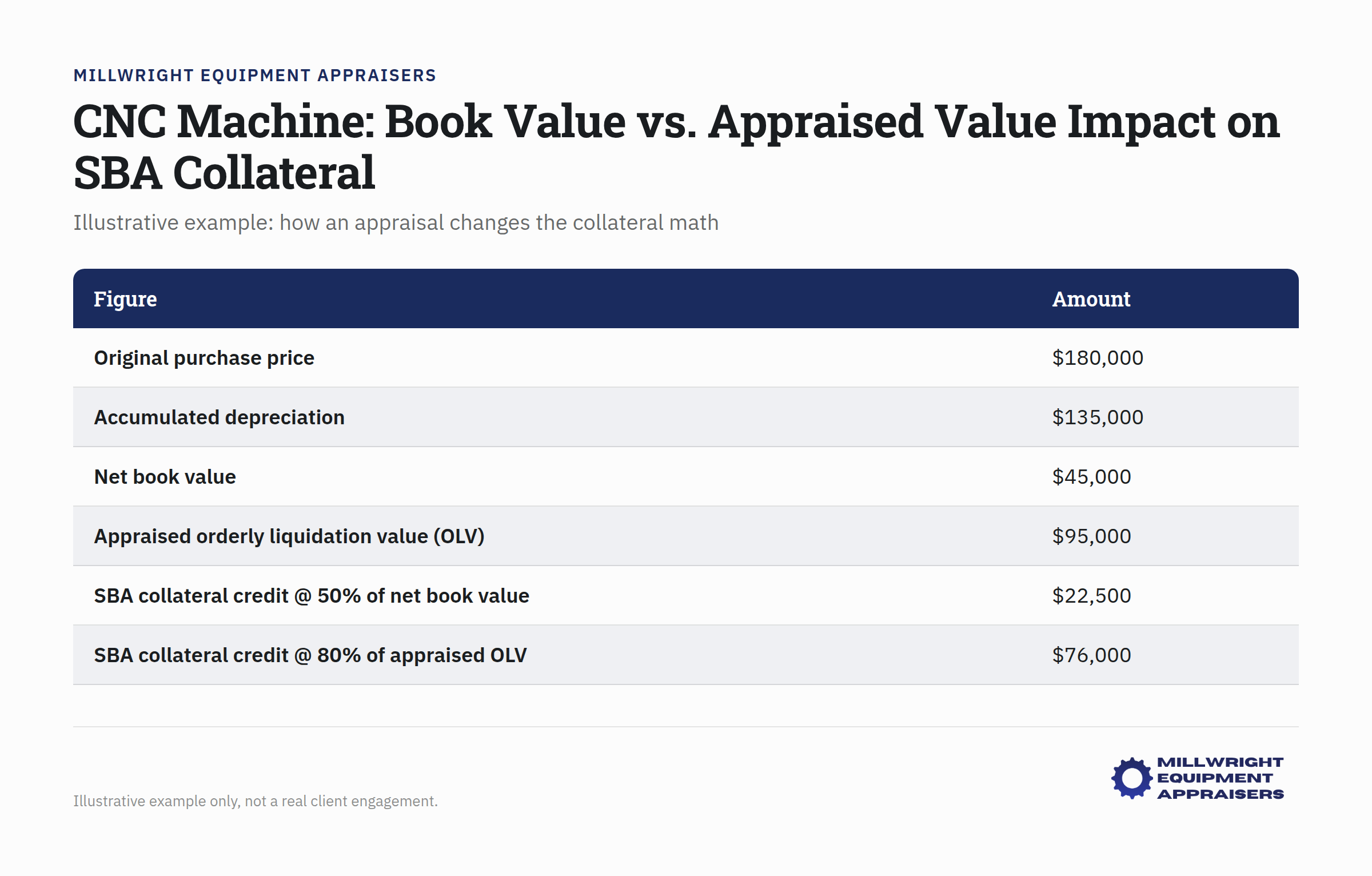
A manufacturing business bought a CNC machine five years ago for $180,000. Under its depreciation schedule, accumulated depreciation now stands at $135,000, leaving a net book value of $45,000. An independent appraiser inspects the machine, confirms it's in good working condition with moderate hours, and concludes an orderly liquidation value of $95,000 based on demand in the used-machinery market.
| Figure | Amount |
|---|---|
| Original purchase price | $180,000 |
| Accumulated depreciation | $135,000 |
| Net book value | $45,000 |
| Appraised orderly liquidation value | $95,000 |
| SBA collateral credit at 50% of net book value | $22,500 |
| SBA collateral credit at 80% of appraised OLV (OLA-supported) | $76,000 |
Without the appraisal, the lender can only count $22,500 of this machine toward collateral. With an Orderly Liquidation Appraisal on file, that figure jumps to $76,000, more than triple the unsupported number. For a borrower whose deal is close to the fully-secured threshold, that gap can determine whether the loan closes as structured or requires additional collateral or equity.
What Lenders Look for in a Collateral Valuation Report
Lenders and CDCs review equipment appraisal reports against a fairly consistent checklist before accepting them for SBA collateral purposes:
- USPAP compliance: The report must be prepared in accordance with the Uniform Standards of Professional Appraisal Practice, published by The Appraisal Foundation.
- Appraiser credentials: Lenders look for credentials such as the ASA (American Society of Appraisers) or the CMEA designation recognized through NEBB, signaling the appraiser has formal training in machinery and equipment valuation.
- Asset-by-asset detail: Make, model, serial number, age, condition, and hours or usage for each piece of equipment, not a lump-sum estimate.
- A clearly stated value premise: Orderly liquidation value, fair market value, or forced liquidation value, spelled out so the lender knows exactly what recovery scenario the number reflects.
- Photographs and inspection documentation: Evidence the appraiser physically reviewed the equipment rather than relying solely on a list or spreadsheet supplied by the borrower.
Why SBA Loans Require an Independent Third-Party Appraiser
SBA loans in particular lean on independent appraisals rather than the borrower's own equipment list or depreciation schedule because of conflict-of-interest concerns baked into the transaction itself. A borrower (or a seller in an acquisition) benefits from a higher stated value, and an internal depreciation schedule was built for tax purposes, not for underwriting a specific loan against a specific piece of collateral.
SOP 50 10 updates have also pushed lenders to formally document any collateral shortfall rather than leaning on strong cash flow to paper over a weak collateral position, a shift industry guidance on SBA collateral and equity injection rules describes as a meaningful change from prior practice. An arm's-length appraisal report, tied explicitly to the net book value comparison SOP requires, gives the lender a number it can defend to SBA examiners and to its own credit committee.
It's also worth noting that equipment appraisals and mandatory business valuations serve different triggers under SOP. SBA generally requires an independent business valuation when financing minus the appraised value of real estate and equipment exceeds $250,000, a calculation that industry guidance on SBA business valuation requirements explains in detail. A properly appraised equipment value can shrink that residual figure enough to keep a deal under the threshold, which is one more reason lenders want the equipment number nailed down early rather than estimated late in underwriting.
Getting an Equipment Appraisal Before You Apply
Ordering the appraisal before submitting the loan package, rather than after a lender flags the equipment list, tends to save weeks in underwriting. We price machinery and equipment appraisals as a fixed fee, quoted after we scope the assignment based on the number of assets, the intended use of the report, and how detailed the analysis needs to be, never billed hourly. For most collateral engagements involving standard industrial or production equipment, that typically starts in the range published for machinery and equipment appraisals generally, with more complex fleets or specialized machinery scoped individually.
If you're preparing an SBA 7(a) or 504 application and equipment is part of the collateral package, getting the appraisal scoped early gives your lender the documentation it needs without a mid-underwriting scramble. Our heavy machinery appraisal team can help determine what level of detail your lender's credit file will require before you submit.
Ready to get your equipment appraised for an SBA or bank financing application? Request an appraisal and we'll scope the assignment around your lender's requirements.
This article is provided for general informational purposes only and does not constitute legal, tax, or financial advice. Readers should consult a qualified attorney, CPA, or their SBA lender regarding their specific circumstances.