
Blog
What Counts as a Qualified Appraiser Under IRS Rules for Equipment Donations
Not every credentialed appraiser can sign the Form 8283 for your donated machinery. This guide explains the two paths the IRS recognizes for a qualified appraiser and who is automatically disqualified from the job.
When a machine shop, farm, or manufacturer donates equipment to a school or nonprofit and the claimed deduction clears $5,000, the IRS doesn't just want an appraisal. It wants one signed by a specific kind of appraiser. Getting the dollar threshold right means nothing if the person who signs Part IV of Form 8283 doesn't meet the IRS definition of a qualified appraiser. This piece covers exactly who that person can be, who is barred from the role, and why general appraisal experience isn't automatically enough for a lathe, a combine, or a fleet of forklifts.
If you're still working out whether your donation even crosses the reporting threshold, our equipment donation threshold guide covers that separately. This article assumes you already know an appraisal is required and need to know who's allowed to write it. Our equipment appraisal for charitable donation service exists precisely because this distinction trips up so many donors.
Who Can Sign a Qualified Appraisal for Donated Equipment?
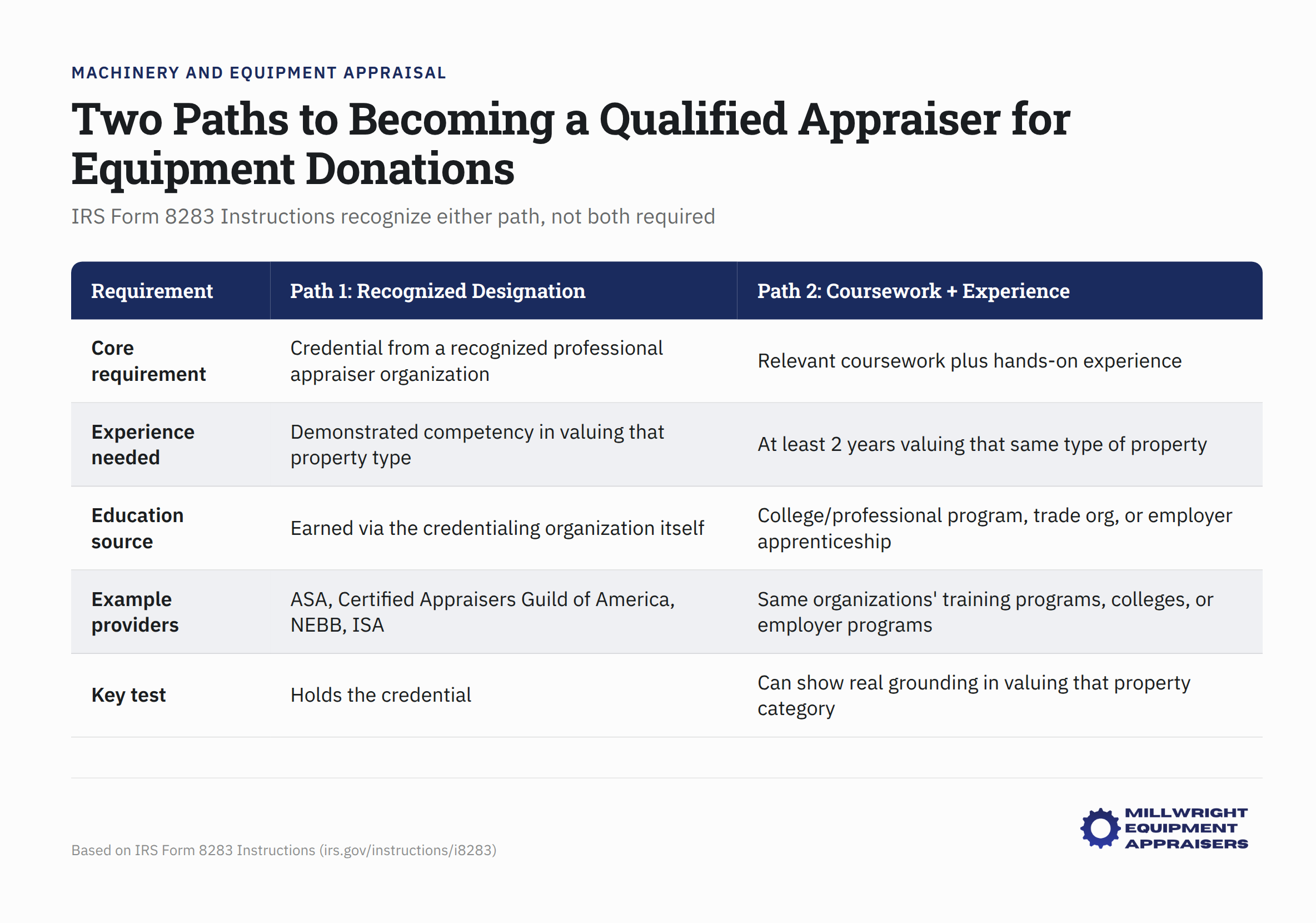
Under the IRS Form 8283 Instructions, a qualified appraiser must satisfy one of two paths. Either path is acceptable; the IRS doesn't require both.
- Path one, recognized designation: The appraiser holds a credential from a generally recognized professional appraiser organization, earned through demonstrated competency in valuing the specific type of property being donated.
- Path two, coursework plus experience: The appraiser has completed professional or college-level coursework relevant to valuing that type of property and has at least 2 years of experience valuing that same type of property.
For machinery and equipment, that coursework can come from a professional or college educational program, a trade or appraiser organization that regularly offers valuation education (the kind of training the American Society of Appraisers, the Certified Appraisers Guild of America, NEBB, or the International Society of Appraisers provide), or an employer apprenticeship or education program comparable to college-level coursework. The point isn't the diploma. It's whether the appraiser can demonstrate real grounding in how that category of property is valued.
Why General Real Estate or Antiques Experience Doesn't Qualify
An appraiser's designation or coursework has to match the property on the donation receipt. A credential earned for appraising real estate, fine art, or antiques doesn't establish competency to value a CNC machine, a dump truck, or a commercial oven, because the valuation drivers are different.
Machinery and equipment valuation depends on industrial, commercial, technical, or functional characteristics: hours on the meter, remaining useful life, obsolescence of control systems, maintenance records, and the depth of the secondary market for that specific make and model. An appraiser whose background is in residential real estate or decorative antiques typically has none of that frame of reference. Publication 561 makes clear that fair market value for used property has to reflect the price a willing buyer and willing seller would actually agree to, with both parties reasonably informed, and an appraiser who doesn't know the equipment market can't credibly reach that number.
Watch out: A dealer quote or an auctioneer's estimate letter is not a substitute for a qualified appraisal, even when the person writing it has decades of experience moving equipment. Those documents usually lack the required valuation methodology, the comparable-sales analysis, and the signed declaration the IRS expects.
The Declaration Appraisers Must Sign on Form 8283
Form 8283, Part IV, requires the appraiser to sign a declaration attesting to their qualifications and acknowledging the penalties tied to a substantial or gross valuation misstatement. This is the appraiser certifying their own competence under penalty of those rules, not a rubber stamp.
The declaration also requires the appraiser to confirm they are not barred from practicing before the IRS. An individual who has been barred from practice before the IRS at any point in the 3 years before the appraisal date cannot serve as a qualified appraiser, regardless of their designations or experience.
It's worth separating this from the donee's role. When the receiving nonprofit signs Part V of Form 8283, that signature only acknowledges receipt of the property. It does not make the donee organization, or anyone at it, a qualified appraiser, and a donee's staff member should never be the one signing Part IV.
Who Is Disqualified From Appraising Your Donated Equipment
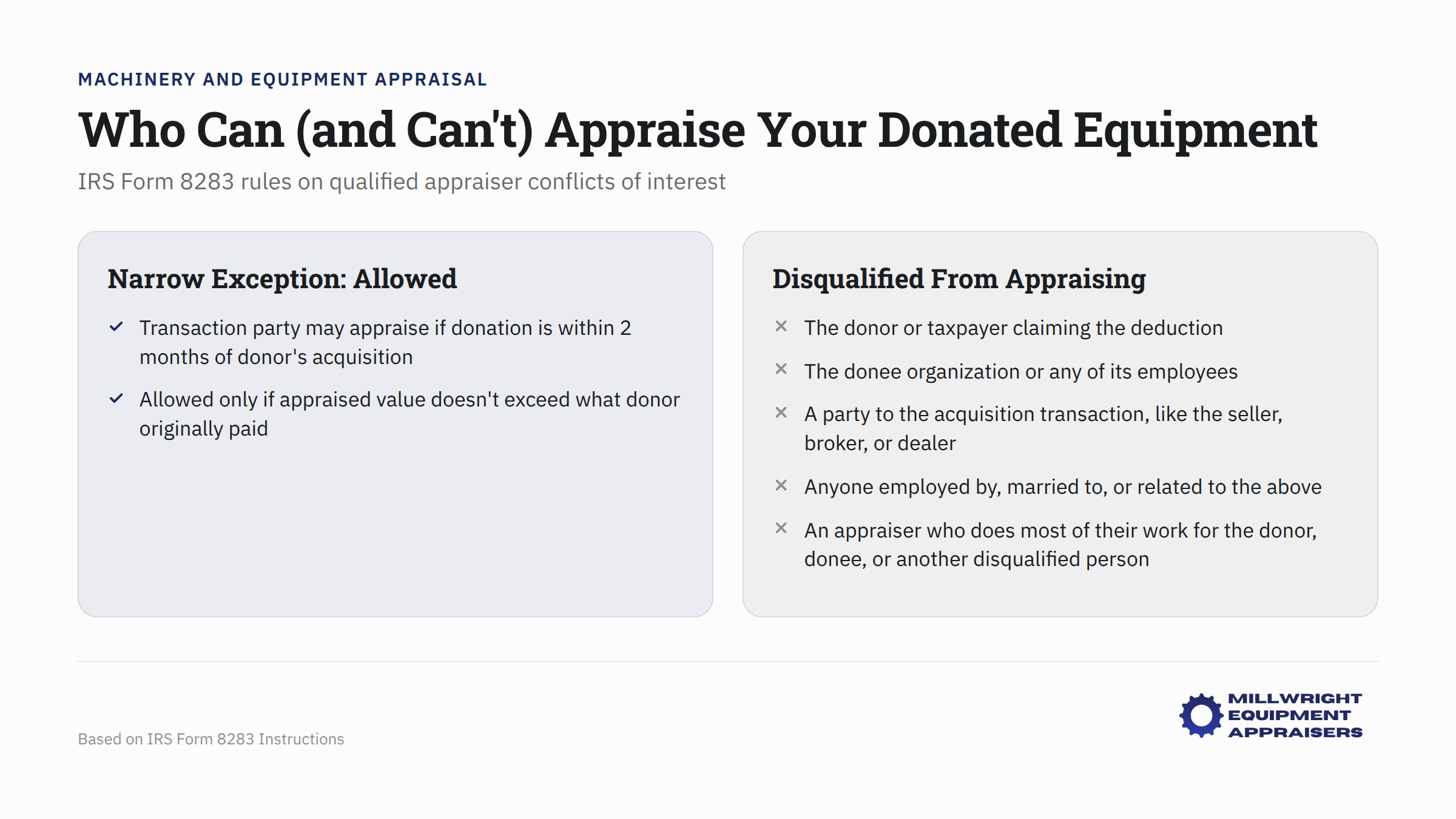
Even someone who clears the designation or coursework bar can still be barred from the assignment because of their relationship to the transaction. The IRS Form 8283 Instructions list several categories of people who cannot act as the qualified appraiser for a given donation:
- The donor making the contribution, or the taxpayer claiming the deduction.
- The donee organization receiving the equipment, or anyone employed by it.
- A party to the transaction in which the donor acquired the property, such as the seller, broker, or dealer who sold the equipment to the donor.
- Anyone employed by, married to, or related to any of the people or parties listed above.
- An appraiser who performs the majority of their appraisals during the tax year for the donor, the donee, or another disqualified person. That pattern signals the appraiser isn't independent enough, even without a direct relationship to this specific donation.
There is one narrow exception. A party to the acquisition transaction, like the dealer who originally sold the equipment, can serve as the appraiser if the donation happens within 2 months of the donor's acquisition of the property and the appraised value doesn't exceed what the donor originally paid. Outside that specific window, the conflict of interest rule applies.
Why Contingent Fees Disqualify an Appraisal
An appraiser's fee can never be tied, even partly, to a percentage of the value they conclude. A fee structure like that gives the appraiser a financial incentive to inflate the number, and the IRS treats an appraisal built on a contingent fee as disqualified outright, regardless of how credentialed the appraiser is or how sound the methodology looks on paper.
This is one reason a legitimate equipment appraisal is always quoted as a fixed fee, scoped before the engagement begins based on the complexity of the equipment, the number of assets, and the intended use of the report. Fixed pricing isn't just good practice; for donation appraisals it's a requirement baked into the qualified appraiser rules.
USPAP and the Standard Behind the Appraisal
The IRS points appraisers toward the substance and principles of the Uniform Standards of Professional Appraisal Practice (USPAP), developed by the Appraisal Standards Board of The Appraisal Foundation, as the framework for how the appraisal itself should be developed and reported. USPAP governs the mechanics: identifying the property, describing its condition, stating the valuation date and method, documenting comparable sales or other supporting data, and disclosing any restrictions on the property.
A qualified appraiser's credentials and experience answer the question of whether they're allowed to sign the report. USPAP compliance answers the question of whether the report itself holds up. Both have to be true for the appraisal to survive IRS scrutiny, and a donor who only checks one of the two boxes is taking an unnecessary risk with their deduction.
Vetting an Appraiser Before the Donation, Not After
Before equipment leaves the dock for a donee organization, it's worth confirming in writing that the appraiser meets the designation-or-coursework test, has no disqualifying relationship to the transaction, and is quoting a fixed fee rather than a percentage of value. That conversation takes 10 minutes and it's far cheaper than discovering after an audit that the signature on Part IV didn't count.
Our appraisers hold credentials with organizations including the ASA, CAGA, NEBB, and ISA, and every machinery and equipment report we prepare is built in accordance with USPAP and the qualified appraiser standards under Treasury Regulation 1.170A-17. If you're preparing to donate machinery, equipment, or a fleet of vehicles and need a report that will hold up to that standard, our team can scope the engagement and quote a fixed fee before any work begins.
This article is provided for general informational purposes only and does not constitute legal, tax, or financial advice. Readers should consult a qualified attorney or CPA regarding their specific circumstances.