
Blog
How Auction and Marketplace Sales Data Get Used in Equipment Valuation
Equipment appraisal comparable sales come from auction results and online listing marketplaces, but raw prices need adjustment before they mean anything. Here is how appraisers screen and adjust that data to reach a defensible value conclusion.
Anyone can pull up a used dozer listing or an auction result in thirty seconds. Turning that number into a defensible appraised value takes a lot more work. The sales comparison approach is the backbone of most machinery and equipment appraisals, and its reliability depends entirely on how carefully the appraiser sources, screens, and adjusts the comparable sales data behind it.
This matters because two pieces of equipment that look identical on paper, same manufacturer, same model, same year, can sell for very different prices depending on who sold them, how they sold them, and what condition they were in at the time. Our heavy machinery appraisal team works through this adjustment process on nearly every assignment, and the mechanics are worth understanding whether you are a business owner, a lender, or an attorney reviewing a report.
What the Sales Comparison Approach Actually Compares
The sales comparison approach values an asset by comparing it to other, similar assets that have actually sold or are currently offered for sale. When the subject matches a comparable closely on the key variables, appraisers call this a direct match. When no identical comparable exists, which is common for older or customized equipment, the appraiser uses the closest available comparables and adjusts for the differences.
Those differences fall into a handful of recognized elements of comparison:
- Age and condition: A 2014 crawler loader with a rebuilt undercarriage is not the same asset as a 2014 unit that has been run hard with no maintenance records.
- Location: Freight costs and regional demand shift prices, especially for heavy or oversized equipment.
- Date of sale: A comparable from 18 months ago may no longer reflect current market conditions.
- Circumstances of sale: Was the seller under time pressure, or did the asset sell through a normal, unhurried marketing period?
- Level of trade: Dealer sale, private sale, or auction, each sits at a different point in the distribution chain and carries a different price level.
Getting these elements right is what separates a USPAP-compliant appraisal from a dealer quote or an auctioneer's estimate. Our comparison of dealer and auctioneer estimates against a compliant appraisal goes deeper into why that distinction matters for lenders and courts.
Where Comparable Sales Data Comes From
Appraisers pull comparable sales from several categories of sources, and each one carries a different level of reliability. Auction results, such as those published through Ritchie Bros. sale results, show consummated transactions: someone actually paid that price for that asset on that date. That makes auction data valuable, but it also reflects the auction level of trade, which is not the same as a retail or dealer sale.
Online listing marketplaces, including Machinery Trader and Rock & Dirt, show asking prices rather than confirmed sale prices. These sources are useful for tracking what sellers believe the market will bear and for finding a larger pool of comparable equipment, but an asking price is not evidence of what a buyer actually paid. Appraisers also draw on used equipment dealer inventories, internal client fixed-asset ledgers, leasing company data, and trade publication classifieds, cross-checking multiple sources whenever possible rather than relying on a single listing.
Watch out: A single high or low sale can distort a value conclusion if it is treated as representative. Comparable sales should be screened for outliers, sales that differ sharply from the rest of the group, before they get used in the analysis. An outlier is not automatically wrong, but it usually means something about that transaction (financing terms, a rushed sale, a non-arm's-length buyer) needs to be understood before the data point is used or excluded.
Why Level of Trade Changes the Adjustment
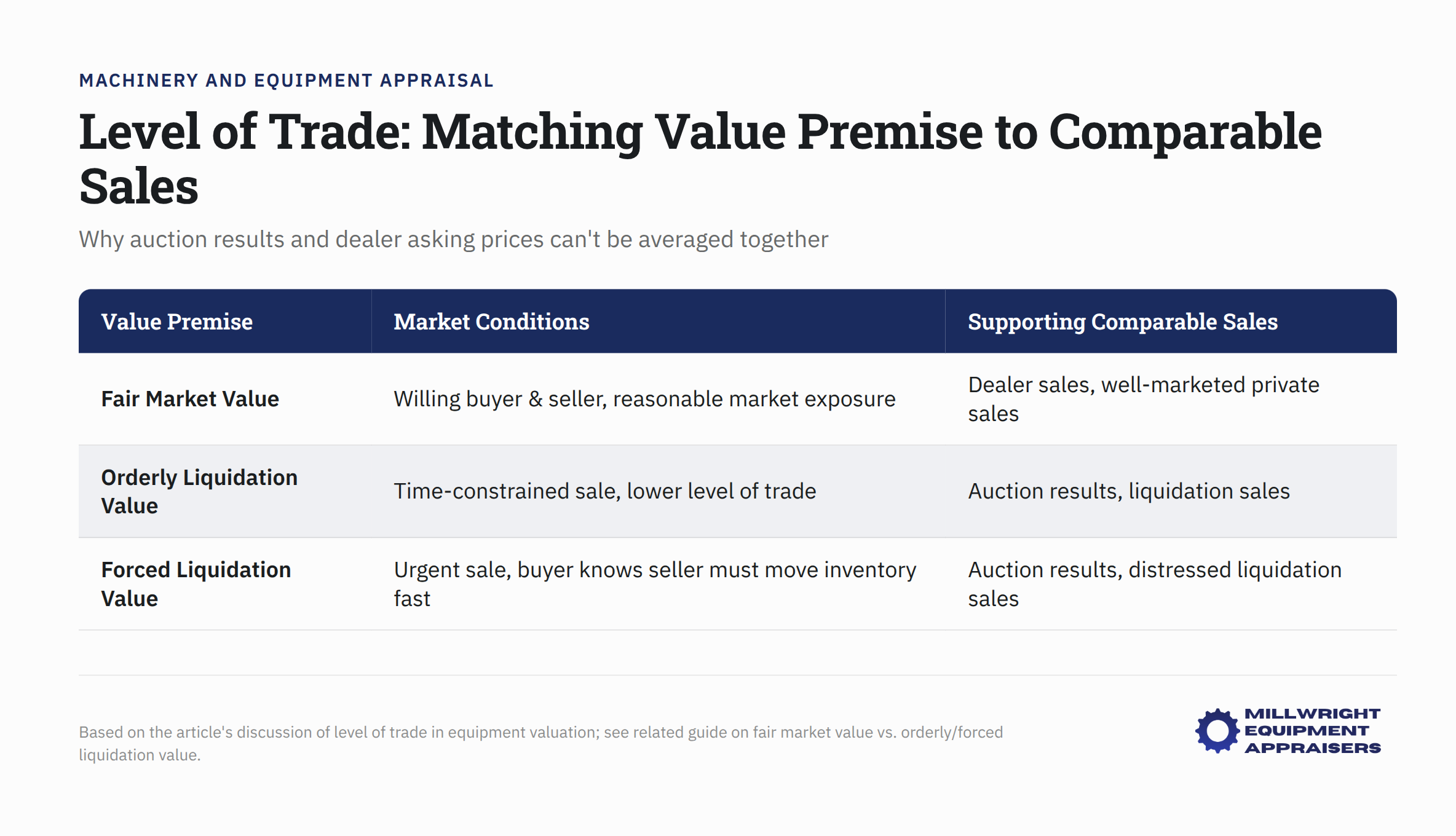
The same physical asset can have several different values depending on the intended use of the appraisal, and the level of trade of the comparable sales has to match the value premise being appraised. Fair market value typically reflects a sale between a willing buyer and willing seller with reasonable exposure to the market, often approximated by dealer or well-marketed private sales. Orderly liquidation value and forced liquidation value both sit at a lower level of trade, reflecting sales made under time constraints, often through auction, where buyers know the seller needs to move inventory quickly.
That is why an appraiser cannot simply average an auction result with a dealer's retail asking price. Doing so blends two different levels of trade into a single figure that represents neither one accurately. Our guide to fair market value versus orderly and forced liquidation value covers how these premises diverge and why the choice of premise drives which comparables belong in the analysis.
The Adjustments Every Comparable Needs
Before a comparable sale price can be applied to a subject asset, it typically needs to be adjusted for several factors that have nothing to do with the equipment's inherent quality:
- Seller type: Dealer sales include a markup for reconditioning, warranty, and sales support. Private sales and auction sales generally do not.
- Listing versus verified price: An asking price on a marketplace listing has not been tested by a buyer. A hammer price at auction or a closed transaction price is confirmed.
- Buyer's premium: Most auctions add a buyer's premium, commonly in the 10% to 15% range, on top of the hammer price. The all-in cost to the buyer, not the bare hammer price, is the figure that belongs in the comparison.
- Freight and delivery: If the comparable's price excluded transport and the subject appraisal needs a delivered value (or vice versa), that gap has to be added or removed.
- Warranty versus as-is condition: A dealer sale with a 90-day warranty is not equivalent to an as-is auction sale with no recourse.
- Time on market and sale date: A sale that closed quickly after listing suggests strong demand; a sale that sat for months suggests the asking price was too high. The sale date also needs to be reasonably close to the appraisal's effective date, or adjusted for market movement between the two.
A Worked Example: Adjusting Two Comparables to One Subject
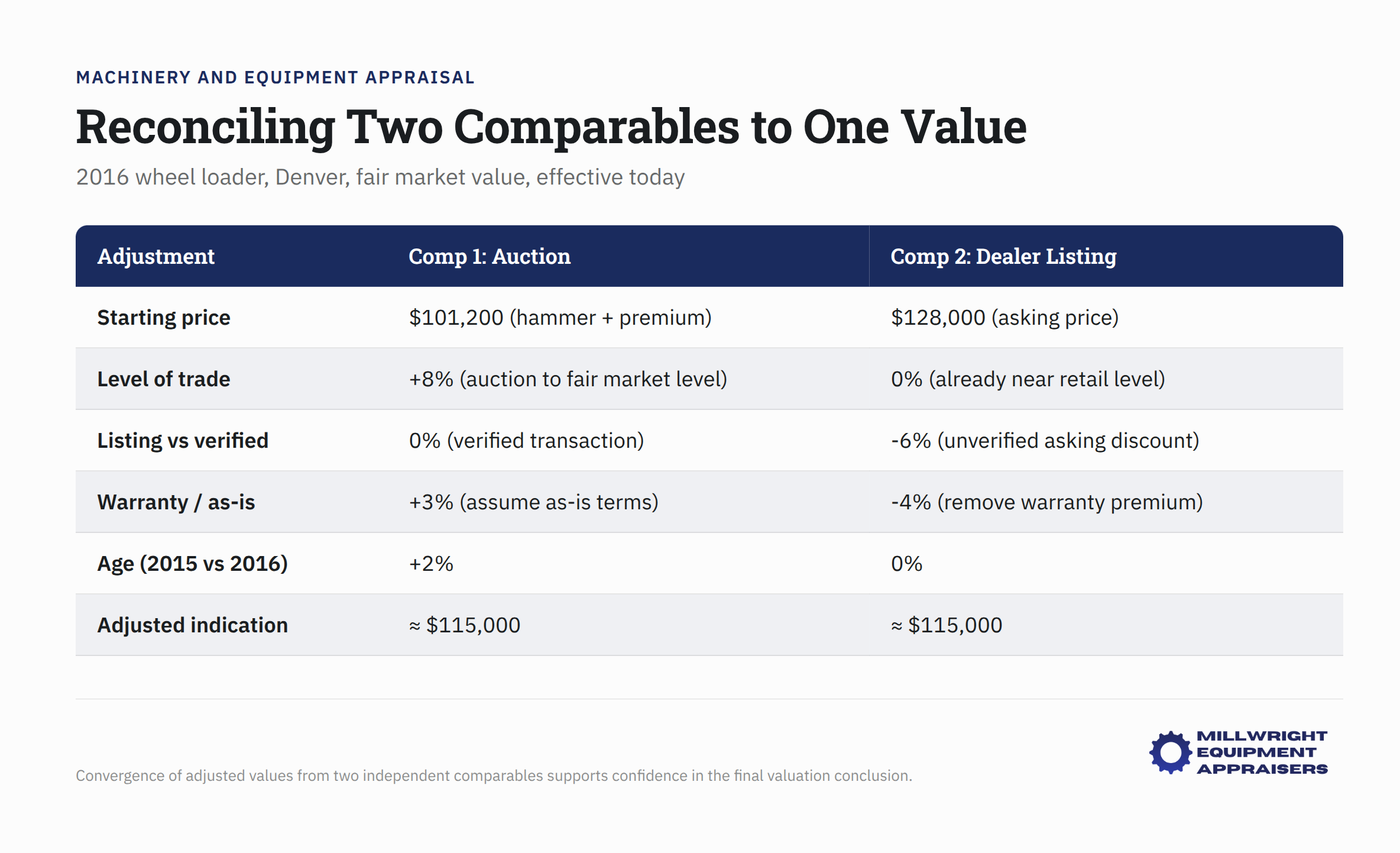
Suppose the subject asset is a 2016 wheel loader, good condition, located in Denver, being appraised at fair market value with an effective date of today.
Comparable 1 (auction): A 2015 wheel loader of the same model sold at a Ritchie Bros. auction six months ago for a hammer price of $92,000, with a 10% buyer's premium bringing the total to $101,200. It sold as-is, with no warranty, and the buyer arranged their own freight.
Comparable 2 (marketplace listing): A 2016 wheel loader of the same model is listed on Machinery Trader through a dealer for $128,000, including a 90-day warranty and free local delivery. It has been listed for 45 days.
Here is how each comparable gets adjusted toward the subject:
| Adjustment | Comparable 1 (Auction) | Comparable 2 (Dealer Listing) |
|---|---|---|
| Starting price | $101,200 (hammer + premium) | $128,000 (asking) |
| Level of trade adjustment | +8% to move from forced/auction level toward fair market level | 0% (already near dealer/retail level) |
| Listing vs verified | 0% (verified transaction) | -6% (unverified asking price, typical discount to close) |
| Warranty/as-is | +3% (subject assumed to carry standard as-is terms similar to comp 1) | -4% (remove warranty premium not present in subject terms) |
| Age (2015 vs 2016 subject) | +2% | 0% |
| Adjusted indication | approximately $115,000 | approximately $115,000 |
Both comparables, despite starting nearly $27,000 apart, converge on a similar adjusted figure once the level of trade, verification status, warranty terms, and age are accounted for. That convergence is what gives an appraiser confidence in the final value conclusion. If the two comparables had landed far apart after adjustment, that would signal a need for additional comparables or a closer look at one of the transactions for outlier characteristics.
Screening for Outliers and Finalizing the Conclusion
Before any comparable makes it into a final analysis, the appraiser should ask whether the sale reflects an arm's-length transaction at the intended level of trade. Sales between related parties, sales bundled with other assets, or sales made under unusual financing terms can all skew the raw price without reflecting the equipment's true market value. The smaller the pool of available comparables, the more scrutiny each one deserves.
Once the outliers are screened out and the surviving comparables are adjusted for seller type, verification status, buyer's premium, freight, condition terms, and timing, the appraiser reconciles the adjusted figures into a single supported value conclusion, or a value range, depending on the intended use of the report.
Why This Level of Detail Matters for Your Appraisal
A number pulled straight from an auction result or a marketplace listing is a data point, not an appraisal. Lenders, courts, the IRS, and insurers all rely on the adjustment process described above to know that the concluded value reflects a genuine market position rather than one seller's asking price on one day.
Our appraisers hold credentials with organizations including the ASA, CAGA, and NEBB, and every engagement is prepared in accordance with USPAP regardless of asset type. Because these appraisals are quoted as a fixed fee after we scope the assignment, the number of comparables reviewed and the complexity of the adjustment process affect the cost of the report, never the concluded value itself.
If you need a machinery or equipment appraisal built on properly sourced and adjusted comparable sales data, our team is ready to scope your assignment through our request appraisal page.